



There are games you install partly out of curiosity, partly out of brand nostalgia, and partly because you just happen to have a few free minutes. You’re not expecting big emotions or sweeping storylines. Just a mobile CMS — something to tap through while sitting on a train or killing time during a break at work.
And then, suddenly, you catch yourself planning resource production well in advance, remembering character names, and getting genuinely annoyed when your virtual residents once again fail to do exactly what you expected them to do — which, of course, means putting out yet another fire or frantically juggling resources, so that the entire colony doesn’t starve to death.
That’s precisely how it went for me with Fallout Shelter and The Elder Scrolls: Castles — two Bethesda games that, at first glance, look like side projects, but in practice can keep you hooked for hours. I played both, came back to them repeatedly, and ended up spending far more time with them than I originally planned. And that’s precisely why I decided to put them side by side — not as a dry comparison or classic review, but as a personal take from someone who genuinely grew to enjoy this type of gameplay thanks to these two titles.
Bethesda’s Simulators — Famous Universes on a Smaller Scale
Bethesda has long been known for massive, richly built worlds, epic adventures, and memorable stories. Fallout and The Elder Scrolls are franchises that earned their status through massive RPGs with hundreds of quests and sprawling open worlds. That’s exactly why it was so interesting to see the studio bring those gigantic universes into a much smaller, more “casual” form.
Released in 2015, Fallout Shelter was a genuine surprise at the time. A free-to-play CMS set in the Fallout universe that seemingly appeared out of nowhere — and quickly became a massive success. Today, 10 years after its premiere, it is available on numerous platforms, and — most importantly — still holds up remarkably well.

The Elder Scrolls: Castles, on the other hand, is a much fresher project, released in the second half of 2024 and currently available only on mobile devices. Even so, it’s clear that Bethesda treated it as more than just “another mobile spin-off.” The game is obviously built on the foundations of Shelter, while at the same time trying to establish its own rhythm and identity — something that, in my opinion, it pulls off surprisingly well.
The World: An Underground Vault vs. a Medieval Castle
One of the most significant differences between these two games lies in their setting.
In Fallout Shelter, most of the action takes place underground. The vault expands in a limited way horizontally and almost endlessly downward, room by room, and every new construction is a strictly functional decision. Power, water, food, security — everything has to stay balanced because otherwise the whole system starts falling apart. This claustrophobic layout fits the post-apocalyptic Fallout atmosphere perfectly. Even though the visuals are colourful and often humorous, there’s always that underlying sense that one wrong move is enough for everything to spiral out of control.
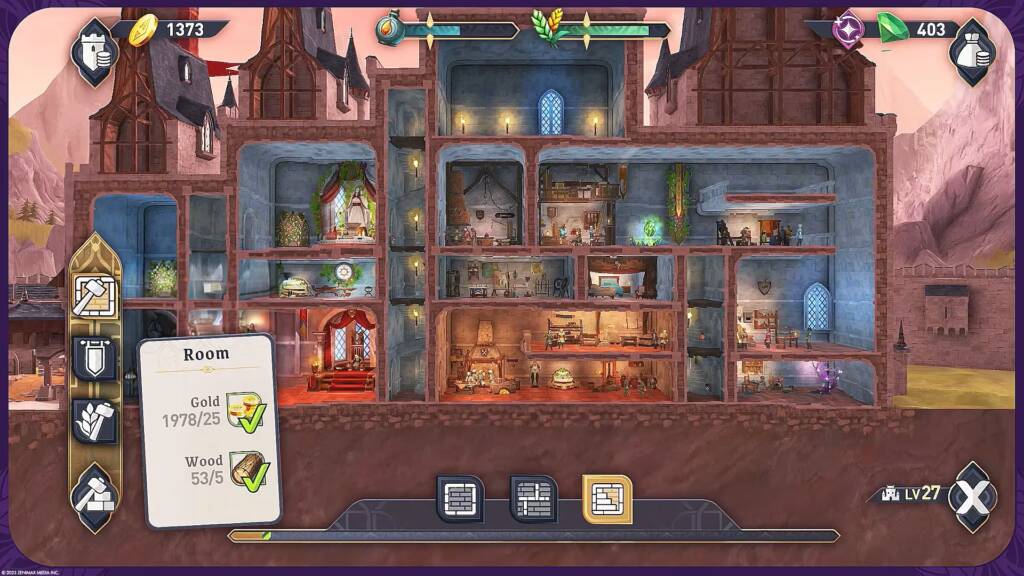
The Elder Scrolls: Castles goes for an entirely different vibe, much closer to what we know from Skyrim or Morrowind. Instead of tight underground corridors, we get a castle that feels alive — from the throne room, through bedrooms and lounges, to numerous workshops, the royal kitchen, and richly decorated shared spaces filled with artifacts. There’s more room to breathe, more characters, and more relationships that go far beyond simple stats. The castle isn’t just a “resource factory” — it’s a place where things are constantly happening, even when you’re not actively producing food or sending residents on missions.
Who Are We, Really, as the Player?
The differences also become clear when it comes to the role the player takes on.
In Fallout Shelter, we technically play as the Overseer. In practice, though, this role is purely symbolic. The Overseer doesn’t physically exist in the game world, has no face, and has no backstory. We act as an impersonal system manager, reacting to crises, assigning tasks, and making sure the numbers add up. The narrative is minimal and episodic — more a collection of small events than a coherent storyline.
In Castles, things work quite differently. We manage the kingdom from the perspective of a ruler whose fate we influence from the very first minutes of the game, starting with the choice of a successor to the murdered king. From there on, we can marry off our ruler, encourage them to have children, appoint heirs, and — in extreme cases — even exile members of the ruling dynasty from the castle. Each member of the dynasty has their own relationships, personal history, and temperament. As a result, the game naturally generates its own stories — sometimes humorous, sometimes unexpectedly dramatic.
Gameplay: Same Foundations, Different Accents
Mechanically, both games are built on similar foundations: expanding a “base,” managing people, resources, and time.
Fallout Shelter is extremely precise and “clean” in how it handles this. Every dweller has stats, every room serves a specific function, and the whole system works like a well-oiled machine — as long as the player stays alert. Expeditions play a major role here and come in two main forms. The first are story-style missions, where we send a selected group of dwellers (or a single brave soul) outside the vault. Once they reach their destination, we take direct control of them, explore locations, fight enemies, gather loot, and — if we’re lucky — bring the entire team back alive.

The second type involves sending well-equipped dwellers into the Wasteland to explore on their own, collecting resources and interesting items over time.
Just as importantly, danger in Shelter can come from literally anywhere and at any moment. If you think a vault sealed by a multi-ton door is impenetrable, think again. Feral ghouls, raiders, and sometimes even Deathclaws can attack from the front, while Radroaches or Molerats can infest any room — especially those rarely used. Add unexpected fires to the mix, and it becomes clear that the vault requires constant attention and fast reactions.
In Castles, classic management is enriched by the previously mentioned dynastic intrigues and moral choices. We’re often forced to decide whether to spend precious resources on organizing a grand ball to improve relations with neighbouring realms or to skip the event and offend our allies, but secure food for the kingdom during difficult months. Every decision affects how the nobility, common folk, individual races, and even specific characters perceive us. Fortunately, aside from fires, there tend to be fewer sudden disasters…
Expeditions also take on a different form. Instead of exploration, we get arena-based combat, structured as waves of increasingly powerful enemies in different locations. Preparing the right team matters a lot, especially since many missions come with additional conditions — such as using only swords, equipping steel armor, or casting a specific spell multiple times. Failing to meet those requirements means receiving only a percentage of the reward. On top of that, there’s Sheogorath’s Gauntlet — a chaotic arena where we face consecutive enemy waves in exchange for valuable loot. It’s a very Elder Scrolls–style mechanic, perfectly fitting the unpredictable nature of Sheogorath himself.
Legendary Characters — Icons of the Series
One of the most recognizable features of Fallout Shelter is its roster of Legendary Dwellers. Amata, Butch, Lucas Simms, Three Dog, Piper, Preston Garvey — for longtime fans, these names instantly bring specific faces and moments from the Fallout series to mind. On top of that, Bethesda has added characters from the Fallout TV show, including Lucy, The Ghoul, Norm, Maximus, and Ma June. It’s hard not to see this as both a confirmation of the show’s canon status and a fun bit of fan service. Who knows — with the second season now out, maybe the list of legendary dwellers will grow even longer?

Castles also features a number of legendary characters from other Elder Scrolls games (including Tiber Septim, Ulfric Stormcloak, and Mai’q the Liar), who usually come with better stats and legendary equipment compared to regular residents. Both these legendary figures and ordinary characters can form dynasties over time, forge alliances, scheme, and make decisions that shape the future of the kingdom. The game regularly confronts us with moral and economic dilemmas — often without a clearly “right” answer. Every choice comes at a cost, and those consequences frequently return many hours later.
Similarities, Differences, and Castles’ Own Identity
There’s no denying it — The Elder Scrolls: Castles is built on the foundations laid by Fallout Shelter. The overall structure, progression pace, and many core mechanics feel immediately familiar. Anyone who has spent time with Shelter will feel right at home during the first hours of Castles.
The key difference lies in what the games choose to emphasize. Fallout Shelter is primarily about systems: efficiency, optimization, and constant vigilance. It’s fast, reactive, and perfectly suited for shorter play sessions, where a few minutes can turn into a quick round of damage control or resource tweaking.
Castles, meanwhile, shifts the focus toward narrative context and long-term consequences. Decisions tend to echo further into the future, relationships between characters matter more, and the game actively encourages emotional investment in the people you’re managing. It asks for patience, but rewards it with emergent stories and a stronger sense of continuity.
Because of that, Castles never feels like a simple reskin of Shelter. Instead, it seems like a conscious evolution — a game that takes proven ideas, adapts them to a different universe, and reshapes them to support its own tone and themes.
Final Thoughts: Why Both Are Worth Playing
I consider both games to be excellent examples of CMS titles set within iconic universes from the Fallout and The Elder Scrolls franchises.
Despite being ten years old, Fallout Shelter still plays beautifully and remains one of the best mobile city management games out there. The Elder Scrolls: Castles is its younger, more ambitious cousin — one that adds more narrative depth, tougher choices, and a stronger sense of character.
I’ve sunk dozens of hours into both, and I know I’ll be coming back to them again. Because occasionally the best way to relax isn’t saving the world in a massive RPG — it’s calmly (or completely chaotically) managing a vault or a kingdom that’s about to go up in flames anyway.