





John Woo’s influence on games is bigger than bullet time. His films helped popularize a way of staging gunfights around movement, destruction, tight spaces, and constant visual pressure, ideas that shooters have kept reinventing from Max Payne and Stranglehold to today’s bodycam-style FPS games.
John Woo’s influence on action games is easy to recognize: dual pistols, slow-motion shootouts, and the kind of gunfights that treat movement as part of the spectacle. His Hong Kong films from the late 1980s and early 1990s gave games a visual language they would keep borrowing for years.
Max Payne is the obvious reference point. Remedy’s Sam Lake has talked about the team watching Hong Kong action films, including John Woo’s work, while trying to translate that kind of slow-motion gunplay into something players could actually control.
But the connection did not stop with bullet time. Over the years, shooters moved from exaggerated dives and carefully staged action toward gunfights that felt rougher, heavier, and more immediate. Games such as Bodycam, and the still-in-development Unrecord, look very different on the surface, but they are chasing a related goal: making the act of moving through a gunfight feel physical, dramatic, and dangerous.
Stranglehold: John Woo gets his own shooter
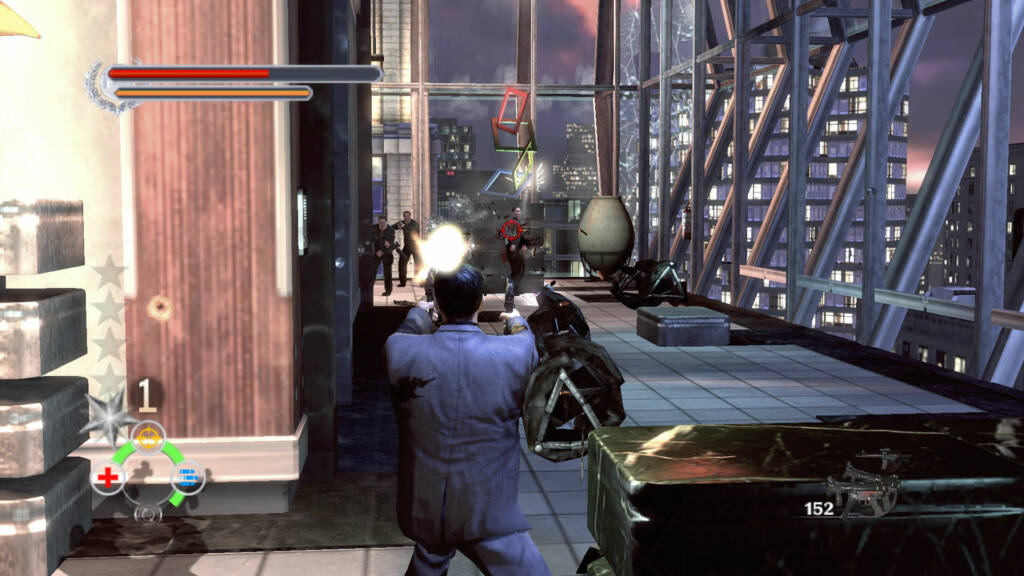
Stranglehold made the connection to John Woo explicit. Released in 2007 and led by creative director Brian Eddy at Midway Chicago, it was developed with Woo as a follow-up to his 1992 film Hard Boiled, with Chow Yun-Fat returning as Inspector Tequila in both likeness and voice.
This was not simply a licensed game borrowing a famous character. Woo was directly involved in the project, reviewing material and helping shape the way Midway translated his style into interactive action.
The result was almost a checklist of Woo imagery turned into mechanics. Tequila Time slowed the action during dives, slides, and other movements, giving players time to shoot while vaulting over counters, sliding across tables, swinging from chandeliers, or riding down banisters.
The important part was that the slow motion was tied to movement. Standing still and firing was rarely the most interesting way to play. The game wanted the player to cross the room while shooting, turning every encounter into a small piece of action choreography.
Destruction was another big part of it. Midway called the system Massive D, and much of the scenery could be damaged or destroyed during a fight. Cover eroded under gunfire, shopfronts shattered, debris filled the air, and larger objects could collapse into the middle of an encounter.
Stranglehold came from a period when shooters were happy to borrow directly from action movies, and it built almost its entire identity around letting the player perform one.
Shattered drywall left a bigger mark than bullet time
Max Payne made slow motion one of the easiest John Woo influences to recognize in games. F.E.A.R. showed why the environment around the gunfight could be just as important.
Monolith filled its office shootouts with breaking glass, clouds of dust, chunks of wall, smoke, muzzle flashes, sparks, and loose objects thrown through the air. Even when the actual encounter involved only a handful of enemies, the room could look devastated by the time it ended.
That gave every shot more visual weight. Bullets did not seem to disappear into an invisible damage system after leaving the barrel. They hit walls, windows, furniture, and the space around the player.
The comparison to Woo is less about direct lineage here and more about the same cinematic principle: a memorable gunfight is not only about who is shooting. It is about what happens to the room while they do it.
Hard Boiled and the shape of modern CQB
The hospital sequence in Hard Boiled may be more useful for thinking about modern shooters than the film’s famous tea house opening.
During the hospital climax, Tequila and Alan move through wards, corridors, doorways, and interconnected rooms while the fight keeps pushing forward. The celebrated extended tracking shot follows them through multiple spaces without breaking the momentum.
There is still plenty of spectacle, but much of the tension comes from the layout itself. Narrow halls limit movement. Doorways hide threats. Corners break sightlines. Enemies can appear only a few meters away, leaving very little time to react.
That structure feels familiar in modern close-quarters shooters, where simply moving through a building can generate tension. Checking the next angle, crossing a doorway, entering a room, and deciding when to push forward can carry an encounter without a huge battlefield or dozens of enemies on screen.
That does not mean every modern CQB game descends directly from Hard Boiled. It means Woo’s hospital sequence demonstrated decades ago how strongly a gunfight can be shaped by architecture, sightlines, and forward movement.
The bodycam era: Close-quarters chaos without the style
Bodycam and Unrecord look almost like a rejection of the action games that openly copied John Woo in the 2000s.
There are no slow-motion dives across restaurant tables. The camera is rougher, weapons move more independently from the center of the screen, visibility is deliberately imperfect, and firefights are presented with the visual language of body-camera footage rather than polished action cinema.
Bodycam, which remains in Early Access, describes itself as a tactical multiplayer FPS built around a true body-camera view. Its developer emphasizes close-quarters combat, physical weapon handling, limited HUD information, and the importance of angles and positioning.
Unrecord is taking that visual idea into a single-player tactical shooter. DRAMA Studios describes it as a narrative FPS seen through a police officer’s body camera, with free aiming, unrestricted hand movement, and combat where mistakes are meant to matter. As of November 2026, it still has no announced release date.
The connection back to Hard Boiled is therefore more thematic than historical. Once shooting starts, all three rely on tight spaces, limited sightlines, rapid changes in threat direction, and the feeling that the room itself is part of the encounter.
The difference is perspective. Woo staged chaos so beautifully that every movement looked choreographed. Bodycam-style shooters try to make chaos feel as though nobody is controlling the camera at all.
Play the shooters in this lineage
The visual language changed dramatically between Max Payne, F.E.A.R., and Bodycam, but all three show different ways shooters can make gunfights feel larger than the enemies standing in front of you.
Explore more action games with G2A Plus
G2A Plus Free lets you earn Plus Points on eligible purchases. Premium adds automatic discounts on eligible items, a monthly game reward, and priority post-purchase support.
From Tequila Time to the body camera
The acrobatics have faded, but the ideas behind John Woo’s gunfights are still easy to find in games.
Max Payne turned Hong Kong action cinema into a player-controlled slow-motion system. Stranglehold copied Woo’s style directly and let players slide across tables while destroying the room around them. F.E.A.R. made the damage to that room almost as memorable as the enemies inside it.
Now games such as Bodycam and Unrecord are stripping away the balletic presentation and replacing it with unstable cameras, physical weapon movement, and a much rougher idea of realism.
Slow motion was the most visible thing games took from Woo’s films. The longer-lasting lesson may be simpler: if the movement, camera, architecture, destruction, and sound all work together, the space around a gunfight can become as important as the shooting itself.