

In the 1990s, World War II largely belonged to strategy games. Real-time strategy titles, turn-based war games and tactical simulations asked players to move units across maps, calculate positioning and plan attacks from above. First-person shooters were already gaining ground, but the Second World War was not yet their defining battlefield.
Hidden & Dangerous, released in 1999, stood out because it tried to bridge that gap. It combined squad management with third-person and first-person combat, along with a level of tactical planning that punished careless play. You controlled a small commando unit, managed equipment and approached objectives methodically. Gunfights were dangerous and often brief. The tone leaned towards military simulation rather than constant spectacle.
What followed in the early 2000s changed the genre completely. World War II shooters became blockbuster entertainment, helped define the modern military FPS, then gradually lost that position as publishers moved towards contemporary and fictional conflicts. They never disappeared, though. By 2026, the setting survives through tactical multiplayer games, smaller simulation-driven projects and occasional big-budget returns.
Table of Contents
- Medal of Honor and the shift to spectacle
- Call of Duty takes over
- Battlefield 1942 and large-scale online war
- Brothers in Arms and tactical discipline
- Side paths and experiments
- The market shifts
- After 2010: Focused, not forgotten
- From centre stage to stable ground
- Games mentioned and G2A.COM offers
Medal of Honor and the shift to spectacle
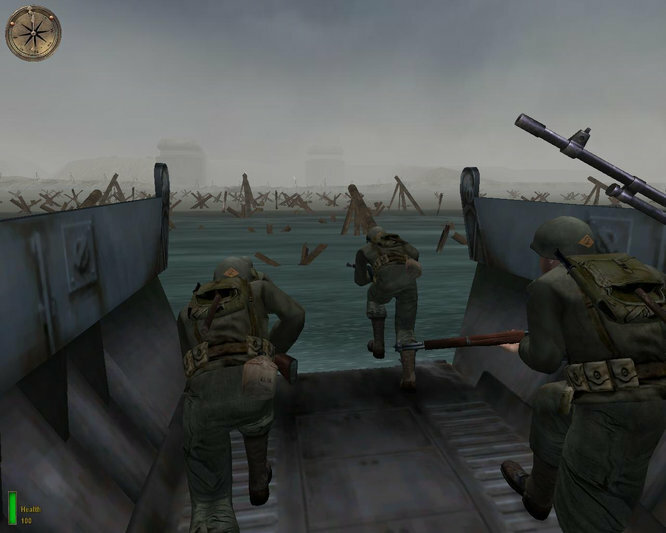
The Medal of Honor series existed before 2002, but Allied Assault marked a turning point for the PC shooter. Developed by 2015, Inc., it embraced cinematic structure in a way few military shooters had done before.
The Omaha Beach landing became iconic almost immediately. Machine-gun fire tore across the sand. Explosions detonated around advancing soldiers. Allied troops pushed forward and fell around you. The sequence was tightly scripted, but it created the impression that the entire battlefield was collapsing into chaos.
Allied Assault used technology based on id Tech 3, the engine behind Quake III Arena. Its environments were detailed for the time, the weapons were responsive and missions moved between stealth, close-quarters fighting and large set pieces. Spearhead and Breakthrough later extended the formula across additional campaigns and fronts.
Multiplayer was simpler than what would come later, but objective modes and recognisable maps helped build a lasting community. Medal of Honor proved that World War II could support fast, accessible first-person action without becoming a hardcore simulation.
Check out Medal of Honor: Allied Assault War Chest on G2A.COM
Call of Duty takes over
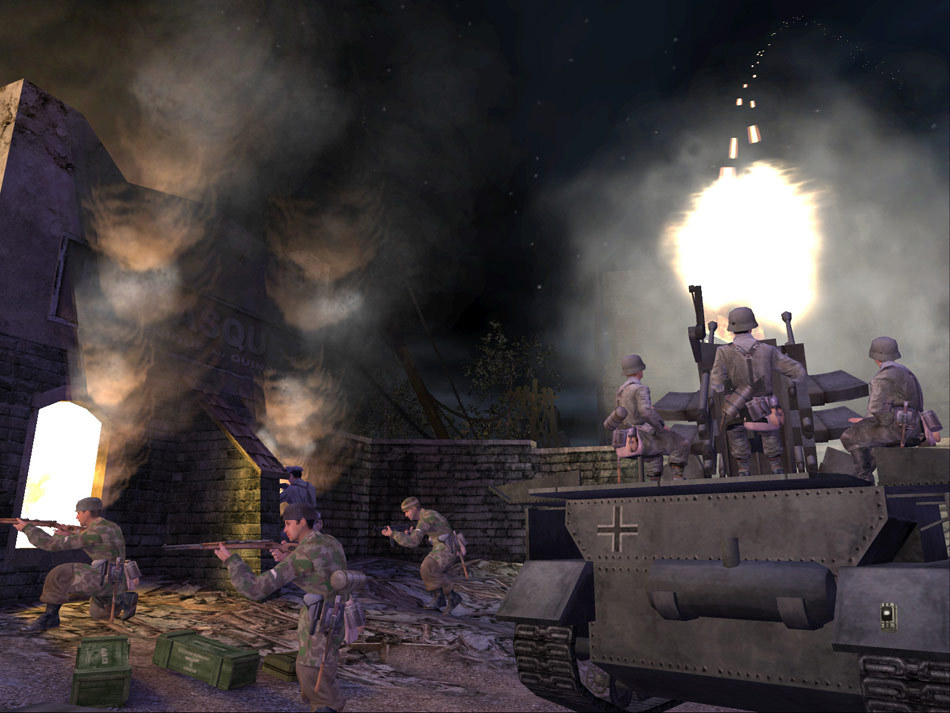
Infinity Ward was founded by developers who had previously worked on Medal of Honor: Allied Assault. Its first game, Call of Duty, arrived in 2003 and immediately felt more kinetic.
Instead of repeatedly sending you into combat alone, missions placed you inside larger military operations. Soldiers shouted directions, returned fire and advanced alongside you. It felt less like a lone action hero clearing a level and more like being one participant in a wider offensive.
The campaign shifted between American, British and Soviet perspectives, giving players a wider view of the conflict rather than locking the entire story to one front.
Call of Duty 2 pushed the formula further in 2005. One of its most influential changes was replacing the traditional health-bar-and-medkit structure with automatically recovering health. Take heavy fire, find cover, recover, then re-engage. Combined with forgiving checkpoints, that system helped keep the campaign moving at a much faster pace.
Check out Call of Duty 2 on G2A.COM
When Call of Duty 4: Modern Warfare arrived in 2007, the franchise moved into contemporary conflict and helped redirect the wider shooter market with it. Modern military equipment, modern settings and highly customisable multiplayer became the new commercial centre of gravity.
Medal of Honor tried to follow that shift with its own modern reboot in 2010 and Medal of Honor: Warfighter in 2012. Neither restored the series to its earlier position. Medal of Honor: Above and Beyond later returned the franchise to World War II in 2020 as a VR game, but the hardware requirement naturally limited its audience.
Battlefield 1942 and large-scale online war
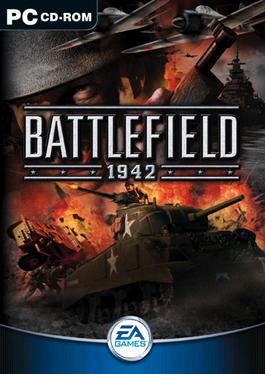
Battlefield 1942 approached the setting from another angle entirely. Released in 2002, it focused less on scripted cinematic missions and more on open, systemic multiplayer battles.
Its headline idea was enormous for the time: 64-player battles combining infantry, tanks, aircraft and naval vehicles on the same map. Control points shaped the front line and drained enemy tickets, while vehicles created opportunities for teamwork that a conventional arena shooter could not reproduce.
The game covered theatres including North Africa, Western Europe and the Pacific. Later Battlefield games moved through modern warfare, Vietnam, World War I and fictional near-future conflicts, but the series’ combined-arms identity began here in a World War II setting.
Brothers in Arms and tactical discipline

Brothers in Arms: Road to Hill 30, released in 2005, emphasised squad tactics over spectacle. Rather than simply advancing through enemy positions, players commanded fire teams and used suppression and flanking as central mechanics.
Suppressive fire carried real mechanical weight. Pin an enemy position and another team could move around the flank. Charge forward without creating that advantage and the game punished you quickly. Terrain, sightlines and squad positioning mattered more than raw reflexes alone.
Earned in Blood expanded the formula later that year, while Hell’s Highway brought the series to a newer generation in 2008. Brothers in Arms never reached Call of Duty’s commercial scale, but it carved out a distinct reputation among players who wanted structure, squad command and tactical pacing.
Check out Brothers in Arms Complete Pack on G2A.COM
Side paths and experiments

As more studios entered the World War II shooter space, not everyone chased the same cinematic formula. Some teams approached the setting from a more mechanical, tactical or multiplayer-focused direction.
Deadly Dozen centred its missions on a group of specialists operating behind enemy lines. Soldiers filled different practical roles, so losing the wrong person could disrupt the entire plan. Preparation and team composition mattered more than simply moving quickly through a level.
Wolfenstein: Enemy Territory emerged as a free standalone multiplayer release built around class roles and layered team objectives. Medics sustained assaults, engineers planted explosives and repaired objectives, while Field Ops supported teammates with ammunition and fire support. Winning meant completing the objective chain, not merely topping the elimination count.
Red Orchestra: Ostfront 41-45 pushed much harder towards realism. Weapons lacked the forgiving handling of mainstream shooters, bolt-action rifles demanded deliberate follow-up shots and exposure in open ground could end an engagement immediately. The slower pace made positioning and awareness central to survival.
Check out Red Orchestra: Ostfront 41-45 on G2A.COM
Commandos: Strike Force tried something stranger: translating a tactical stealth series into a first-person shooter. Players switched between a Green Beret, Sniper and Spy, each designed for different approaches. The transition was uneven, but it showed how thoroughly the FPS boom had reshaped the World War II market.
The market shifts

After Modern Warfare demonstrated the commercial appeal of contemporary combat, major publishers increasingly moved in that direction. Modern weapons created obvious space for attachments and multiplayer progression, fictional conflicts gave writers more freedom, and developers no longer had to work around the familiar visual language of 1940s battlefields.
World War II releases continued, but they stopped dominating the annual shooter calendar.
The big publishers did eventually return. Call of Duty: WWII brought Activision’s flagship shooter back to the setting in 2017, while Battlefield V followed in 2018 with its own large-scale interpretation of the conflict. Those games proved that there was still a blockbuster audience for World War II, but neither triggered another industry-wide rush comparable to the early 2000s.
| Big-budget return | What it brought back | G2A.COM |
|---|---|---|
| Call of Duty: WWII | A cinematic campaign, boots-on-the-ground multiplayer and the franchise’s first major return to WWII in years. | Check offers |
| Battlefield V | Large combined-arms battles, War Stories and a live-service approach to WWII. | Check offers |
After 2010: Focused, not forgotten

Once World War II stopped being the default setting for major military shooters, developers had more room to specialise.
Enemy Front revisited resistance movements in occupied Europe and offered more open mission paths than the tightly scripted shooters that had dominated the previous decade. It did not redefine the genre, but it showed that there was still room for traditional campaign-driven World War II action.
Hell Let Loose pushed in the opposite direction, focusing on coordinated 50-vs.-50 warfare, logistics, command structure and a shifting front line. Individual aim matters, but supplies, spawn placement, armour support and communication frequently decide whether a team can hold ground.
The game remains unusually active in 2026. Update 20 added Juno Beach and Canadian forces in June, while further updates have continued revising weapons, armour and maps. Lake Balaton is planned as the next major Eastern Front battlefield, while Seelow Heights has moved into the 2027 roadmap.
Check out Hell Let Loose on G2A.COM
Enlisted approaches the battlefield differently by giving each player control of a squad rather than a single soldier. You can switch between surviving squad members during combat, which makes positioning and squad composition part of the moment-to-moment action. The game has continued evolving through 2026 with new Battle Pass seasons, technical improvements and ongoing content updates.
Easy Red 2 takes a lower-budget but ambitious simulation-driven approach. Huge battles mix infantry, armour, aircraft, destructible environments and AI-controlled units. Its 2026 updates have continued improving vehicle and infantry AI, tank systems, interface design and weapon handling rather than treating the game as finished and abandoned.
Check out Easy Red 2 on G2A.COM
The Sniper Elite series has become another reliable home for the setting. Sniper Elite: Resistance, released in January 2025, moved the focus to occupied France in a standalone campaign running parallel to Sniper Elite 5. Its open missions combine long-range shooting, stealth, multiple infiltration routes and cooperative play, showing how far the genre has moved from the corridor-heavy campaigns of the early 2000s.
Check out Sniper Elite: Resistance on G2A.COM
From centre stage to stable ground
During the early 2000s, World War II shooters helped define the direction of the FPS genre. Medal of Honor established a cinematic framework. Call of Duty refined pace and accessibility. Battlefield 1942 demonstrated the potential of large-scale combined-arms multiplayer. Brothers in Arms and Red Orchestra proved that the same historical setting could support much slower, more tactical ideas.
The genre did fall away from the centre of the mainstream market, particularly after contemporary warfare became the dominant commercial template. But “fall” is only half the story. Call of Duty: WWII and Battlefield V showed that major publishers could still return to the period, while Hell Let Loose, Enlisted, Easy Red 2 and Sniper Elite have kept the setting active through very different design philosophies.
In 2026, World War II is no longer the automatic setting for every other military shooter. That may actually be healthier for the genre. Developers that return to it now usually need a clearer reason to be there, whether that means tactical coordination, historical simulation, open-ended stealth or a particular battlefield that has not been explored to death.
Games mentioned and G2A.COM offers
The games below cover the full arc discussed in this article, from the tactical experiments that came before the early-2000s boom to the modern military shooters that pulled the market away from World War II and the specialised WWII games that followed. Where a current G2A.COM marketplace route is available, you can check it directly below.
| Game | Era / role in the article | G2A.COM |
|---|---|---|
| Hidden & Dangerous | Pre-boom tactical WWII shooter. | Check bundle |
| Medal of Honor: Allied Assault | Cinematic WWII breakthrough. | Check War Chest |
| Call of Duty 2 | Regenerating-health era of WWII Call of Duty. | Check offers |
| Call of Duty 4: Modern Warfare | The contemporary-war pivot that changed the market. | Check offers |
| Medal of Honor (2010) | Medal of Honor’s move into modern Afghanistan. | Check offers |
| Medal of Honor: Warfighter | The series’ second modern-war entry. | Check offers |
| Medal of Honor: Above and Beyond | VR return to World War II. | Check offers |
| Brothers in Arms: Road to Hill 30 | Squad tactics and suppression. | Check Complete Pack |
| Brothers in Arms: Earned in Blood | Expanded the squad-tactical formula. | Check Complete Pack |
| Brothers in Arms: Hell’s Highway | The later, more cinematic Brothers in Arms entry. | Check Complete Pack |
| Deadly Dozen | Specialist squad combat behind enemy lines. | Check offers |
| Wolfenstein: Enemy Territory | Free class-based objective multiplayer. | Free to play |
| Red Orchestra: Ostfront 41-45 | Realism-focused Eastern Front combat. | Check offers |
| Call of Duty: WWII | 2017 blockbuster return to WWII. | Check offers |
| Battlefield V | 2018 Battlefield return to WWII. | Check offers |
| Enemy Front | More open-ended resistance-focused campaign design. | Check offers |
| Hell Let Loose | 50-vs.-50 tactical multiplayer and logistics. | Check offers |
| Enlisted | Free-to-play squad-based online warfare. | Free-to-play |
| Easy Red 2 | Large-scale simulation-driven WWII combat. | Check offers |
| Sniper Elite: Resistance | Modern open-ended stealth and sniping in occupied France. | Check offers |
G2A Plus: If you are revisiting classic World War II shooters or picking up one of the newer tactical games, G2A Plus can add Plus Points and member pricing on eligible marketplace purchases.