





Do gamers actually hate AI? Not exactly. Our research suggests players are much more selective than the usual “pro-AI vs. anti-AI” debate makes them sound. They are relatively comfortable with AI helping behind the scenes or making NPCs smarter. Let it start writing the story, voicing characters, composing the soundtrack, or replacing artists, though, and the mood changes fast.
There is an even more interesting twist: some of the strongest skepticism comes from people who have never knowingly bought a game containing AI-generated content. Among players who have, negative attitudes drop sharply.
In other words, this is not really a story about gamers rejecting a technology outright. It is about trust, quality, creativity, price, and where players believe the line between useful tool and unwanted replacement should be drawn.
And if publishers want to put “AI-powered” on the box as if that alone will make everyone sprint toward the checkout? The data suggests they may want to rethink that plan.
Table of Contents
- Players are not anti-AI. They are picky about where it shows up
- What actually drives AI skepticism?
- The experience gap: trying it changes the conversation
- Regional differences
- Core gamers are tougher customers, not automatic AI haters
- Frequent gamers want transparency and lower prices
- Experience matters more than ideology
- Where AI gets a pass, and where it does not
- What developers and publishers should take from this
- The bottom line: make a good game first
Players are not anti-AI. They are picky about where it shows up
The overall distribution of attitudes toward AI in video games is relatively even, with the center of gravity leaning slightly neutral-positive. Neutral respondents form the largest group, while strong opponents are a smaller, although still meaningful, segment.
That does not mean players simply shrug when AI enters the conversation. Their judgment is highly conditional.
AI appears to get a much warmer reception when it works in the background or directly improves the act of playing. Applications such as coding support, localization, and dynamic NPC systems are relatively well accepted, including among respondents who are otherwise skeptical of generative AI.
The temperature drops when AI moves into areas associated with authorship and artistic identity.
Graphics, narrative, voice acting, and music are considerably more sensitive categories. Here, consumers are more likely to see AI as replacing human creative work instead of simply helping developers build a better game.
The important distinction: respondents do not appear to reject AI simply because it is AI. They are deciding where human authorship still matters most to them.
What actually drives AI skepticism?
The biggest concerns are not about whether the technology works. They are about what happens to the finished game.
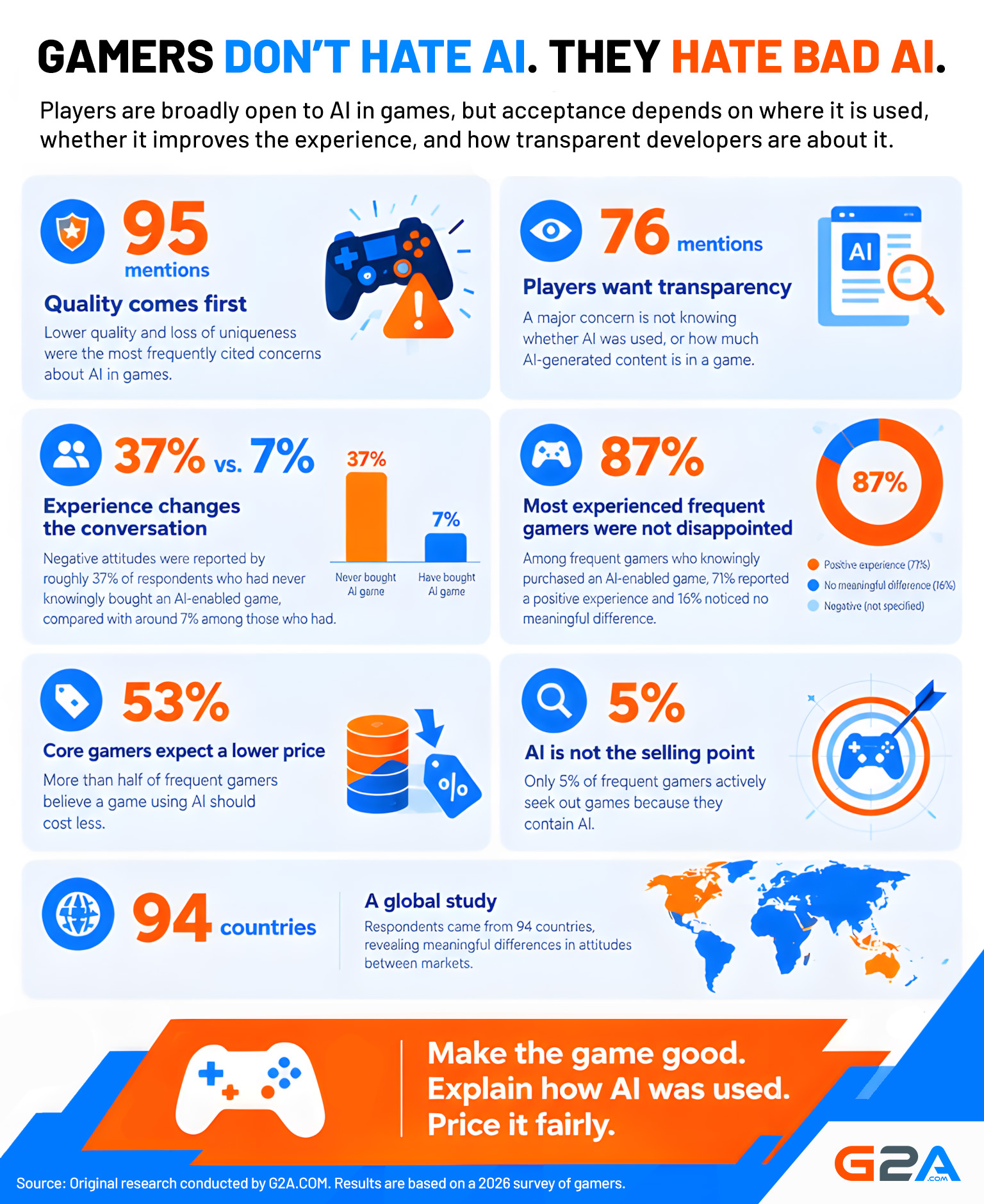
The most frequently cited issue is fear of lower quality and a loss of uniqueness, with 95 indications. Respondents worry that heavier AI use could make games feel generic, repetitive, or less distinctive.
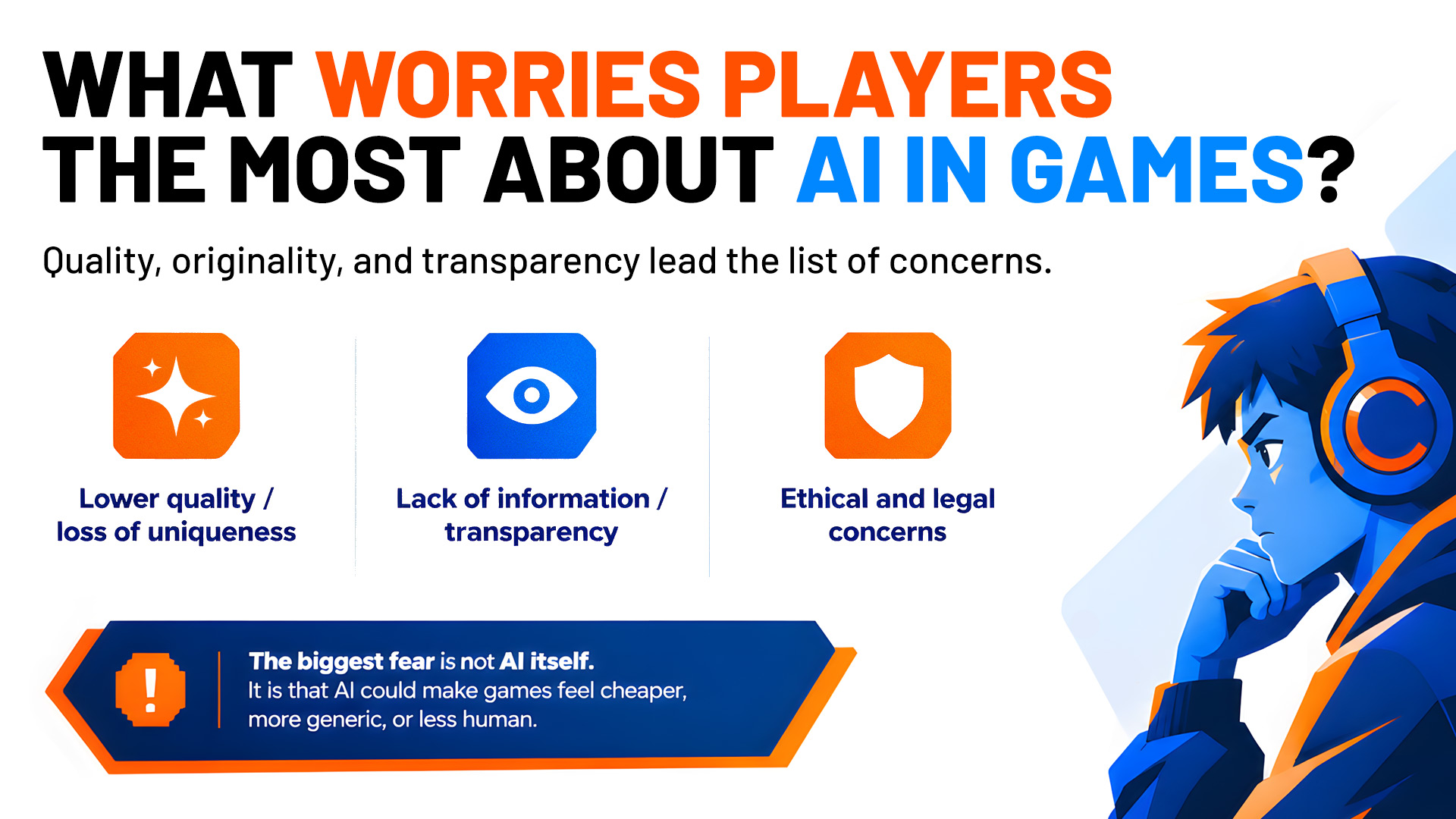
That concern is followed by lack of information and transparency, with 76 indications. Responses here include players feeling misled as customers or simply not knowing how much of a game was generated using AI.
Another 36 indications concern ethical and legal issues, including AI displacing artists and other creators.
Put those concerns together and a clear pattern emerges. Players are asking three questions: Will AI make the game worse? What does it mean for the people making it? And are you telling me the whole story?
That makes disclosure particularly important. A clear AI label or badge could address one of the most common pain points by telling customers whether AI was used and, ideally, where it appears in the game.
The experience gap: trying it changes the conversation
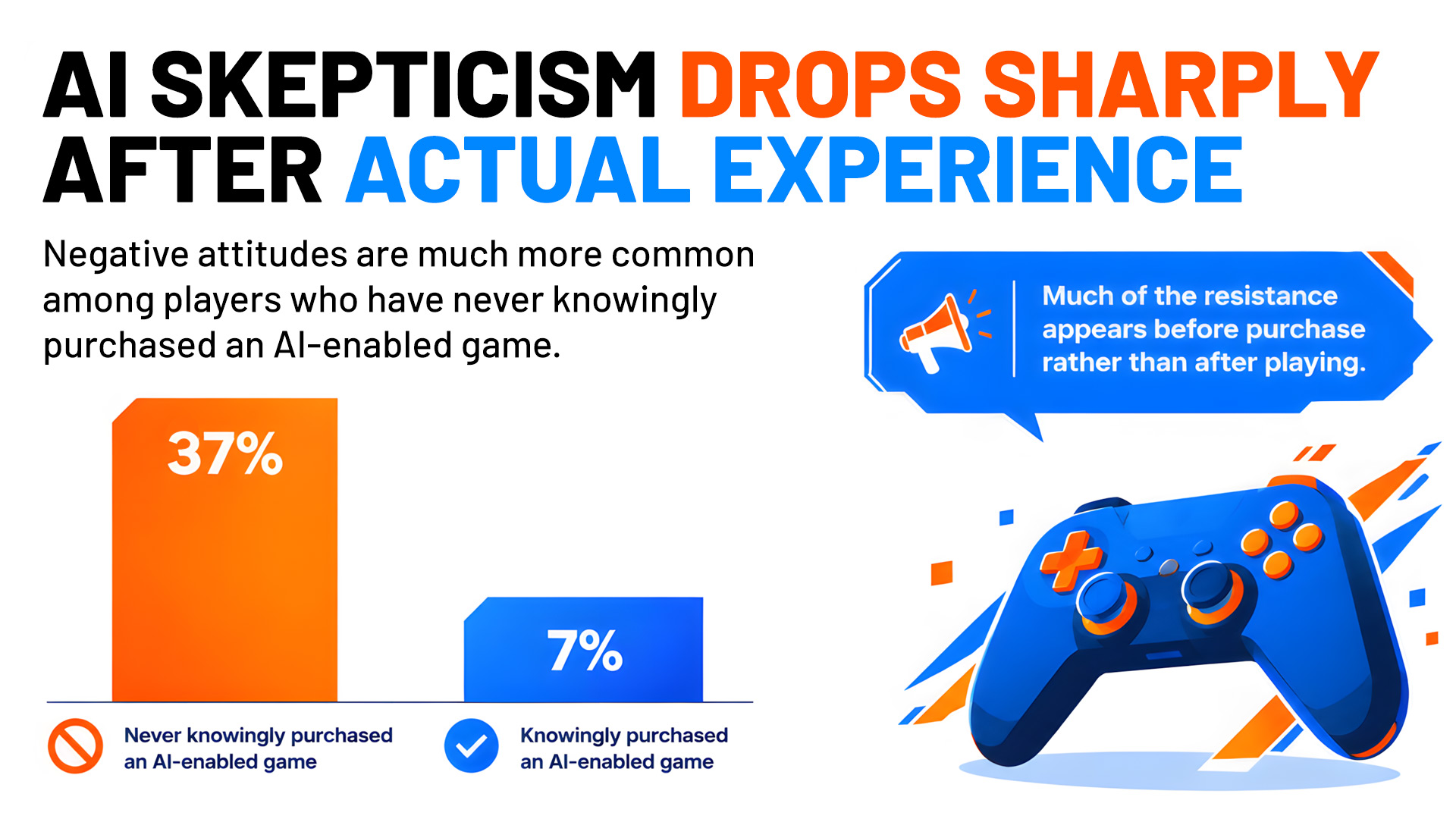
This may be the most striking pattern in the study.
Negative attitudes are significantly more common among respondents who say they have never purchased a game containing AI-generated content. Approximately 37% of this group express a negative attitude toward AI.
Among respondents who have knowingly purchased such a game, that figure falls to approximately 7%.
The reported experiences themselves also lean positive or neutral. According to the supplied findings, among respondents who purchased a game containing AI-generated content and evaluated that experience, 76 were satisfied, 16 noticed no meaningful difference, and 17 were disappointed.
That supports a broader conclusion: many consumers appear to worry that AI will damage game quality before they personally encounter it in a game.
Data check before publication: the supplied findings refer to 171 respondents, but the three stated experience groups total 109 people: 76 satisfied, 16 who noticed no difference, and 17 disappointed. The stated conclusion of roughly 85% positive or neutral is consistent with 92 out of 109 respondents, not 92 out of 171. The underlying dataset should therefore be verified before that figure is published externally.
Subject to that check, the larger pattern remains clear. Disappointment after direct experience appears relatively uncommon, while skepticism is much stronger among consumers who have not knowingly tried AI-enabled games.
That matters commercially. If a meaningful part of the resistance exists before the player reaches the game, reviews, transparent disclosure, demos, gameplay footage, and clear explanations of how AI was used may do more than vague messaging about the technology itself.
Regional differences
The sample covers 94 countries, with the United States accounting for approximately one fifth of the total. Because responses are spread across so many countries, country-level conclusions should be treated as directional outside the largest markets.
Western markets, particularly the United States, United Kingdom, and Europe, are generally more reserved. Neutral attitudes dominate, while the UK is the only larger market showing a slight overall negative tilt.
Several emerging markets are considerably more enthusiastic. Respondents from the Philippines, Brazil, Saudi Arabia, Vietnam, India, and South Africa, alongside the broader regions of Southeast Asia, Latin America, and Africa, tend to report more positive attitudes toward AI in games.
Asia produces the strangest contradiction
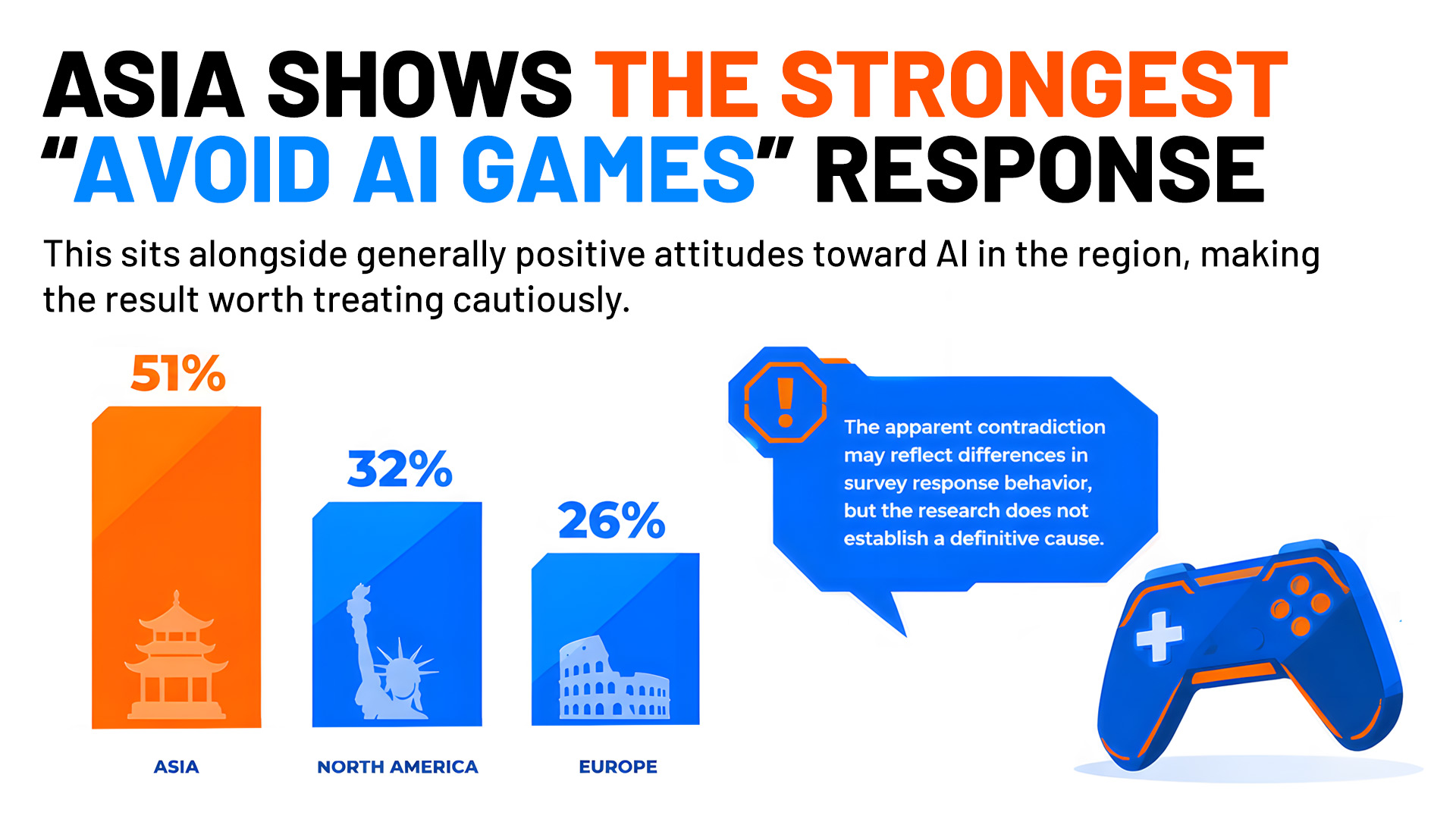
Respondents in Asia show clearly positive attitudes toward AI overall, but they are also the most likely to say they avoid games containing AI regardless of reviews.
One possible explanation identified in the findings is extreme response style, a survey-response tendency in which some respondent groups may be more likely to choose the strongest available options regardless of question direction.
That explanation should remain a hypothesis, not a conclusion. The data establishes the contradiction, but it does not prove its cause.
Price sensitivity also varies geographically. The expectation that games containing AI should cost less is strongest in North America.
Core gamers are tougher customers, not automatic AI haters
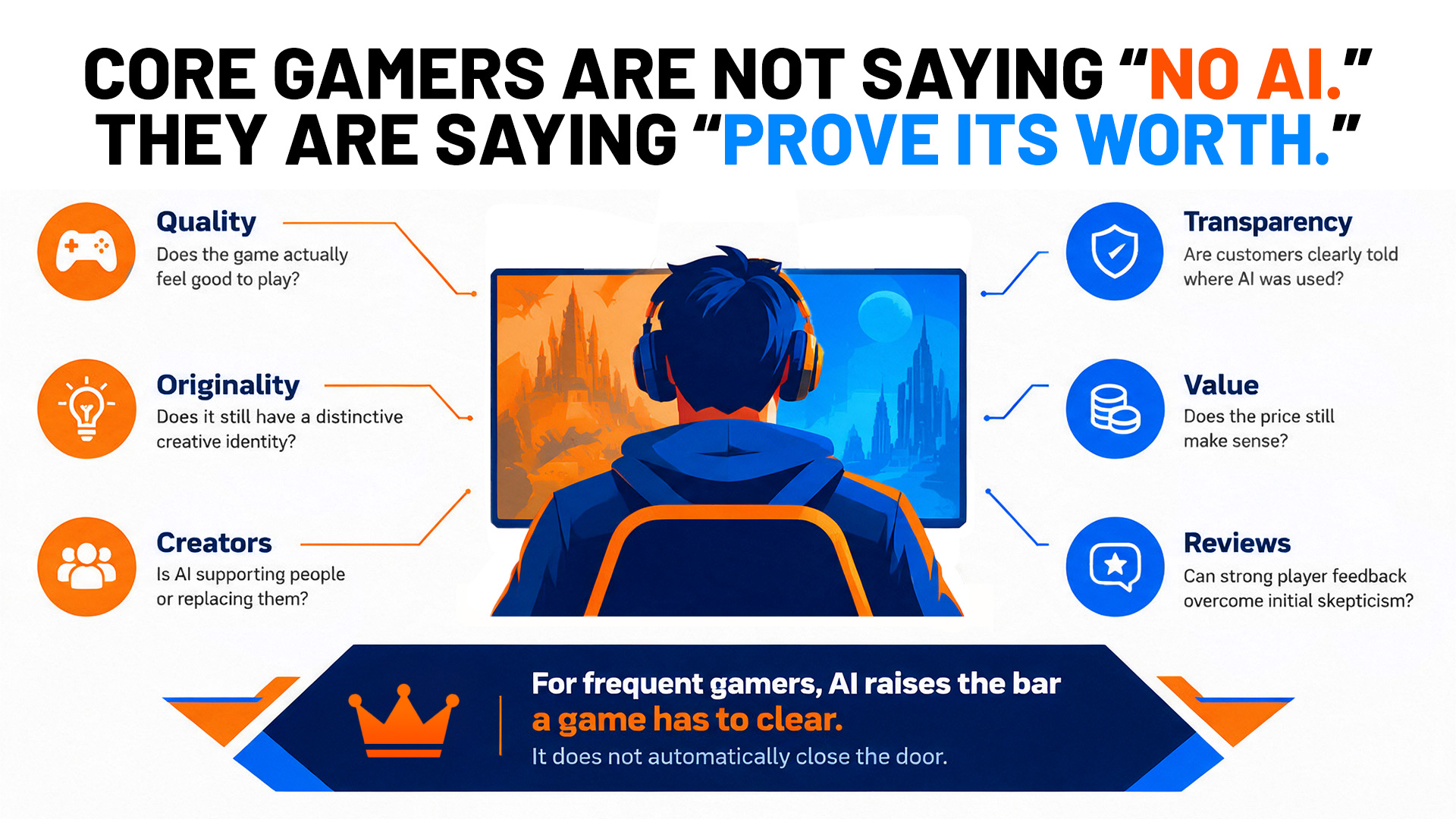
A particularly important group consists of 353 respondents who play games daily or several times per week. They make up roughly three quarters of respondents who supplied information about gaming frequency.
These frequent gamers are more critical of AI than occasional players, but what they are critical about tells us more than the raw negativity itself.
Quality is their leading concern, with 47 indications. Almost neck-and-neck is the belief that AI takes work away from artists, cited 45 times. Another 39 indications concern games potentially losing their unique character.
That sounds less like technophobia and more like anxiety about gaming as a creative culture.
Players who spend a lot of time with games appear particularly sensitive to authorship, originality, and the humans behind the work.
But they are not closing the door.
Among frequent gamers, 34% say only the quality of the game matters, while another 27% would prefer to avoid AI but would still buy a game if the reviews were excellent.
Put those groups together and roughly 60% of frequent gamers remain open to buying an AI-enabled game if it proves itself through quality and strong reviews. For core players, AI is not necessarily a deal-breaker. It simply raises the bar the game has to clear.
Frequent gamers want transparency and lower prices
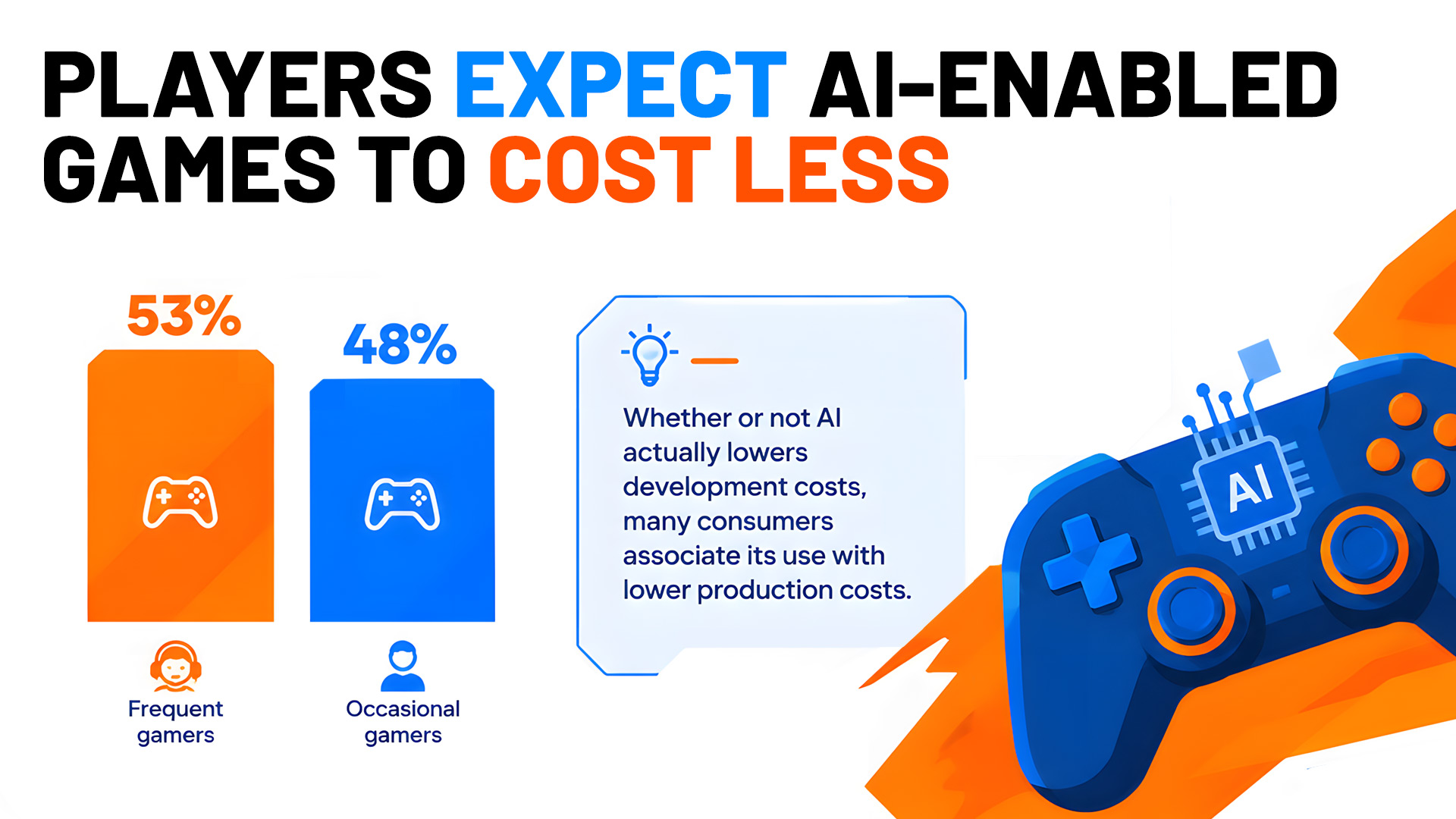
Core gamers are also the most demanding group when it comes to value.
Approximately 53% expect a game using AI to be cheaper, compared with 48% of occasional players.
Whether that assumption reflects the actual economics of development is a separate question. What matters commercially is that the perception exists: if players believe AI reduces production costs, many also expect some of those savings to reach them.
Transparency matters just as much.
Approximately 36% of frequent gamers say they always check whether a game contains AI, while another 30% say they check sometimes. Yet around one third do not know whether they have ever purchased a game containing AI at all.
There is an obvious disconnect here. Players say they want the information, but many do not currently have an easy way to get it.
Gamer’s opinion
If there’s something we don’t understand, we either fear it or attack it. That’s exactly how gaming communities reacted when AI started being talked about as a tool used in game development. Publishers were afraid to discuss it openly, since any mention was met with instant backlash on social media, but at some point they seem to have realized that transparency is the foundation of building trust and relationships with the community.
As gamers, we have nothing against AI being used to create, say, game code, as long as it speeds up the release, helps avoid bugs, improves quality, and optimizes costs, ultimately resulting in a lower price for the product. We are, however, far more sensitive when it comes to what we can see and hear. Art, video, audio: in these areas, we still expect something “made by human hand.” Games are a craft of sorts, and we still care deeply about keeping it that way. A great example was when cosmetic content for Battlefield was created using AI, which drew a very negative reaction from the community. Several more similar stories have surfaced online since.
Personally, as a gamer, I’m starting to see the benefits AI brings to other aspects of gaming. Right now, everyone can find something positive in it, depending on their interests. First and foremost, AI is a great solution for dialing in the optimal settings for any game, and it also helps troubleshoot even the most complex hardware issues. In more in-depth games, depending on the genre, an agent can help you put together any effective character build and pick the right skills, or help you set up your race car ahead of an upcoming event. AI can be your coach, your engineer, and your partner in any game, and that’s great. In the end, how we use it comes down to our own knowledge and imagination.
~ Gascan – gamer, streamer and G2A.COM employee. Follow him on: Twitch, Youtube
A standardized AI disclosure or visible label could reduce that uncertainty without forcing customers to dig through developer interviews, store descriptions, social posts, and forum discussions just to figure out what they are buying.
Experience matters more than ideology
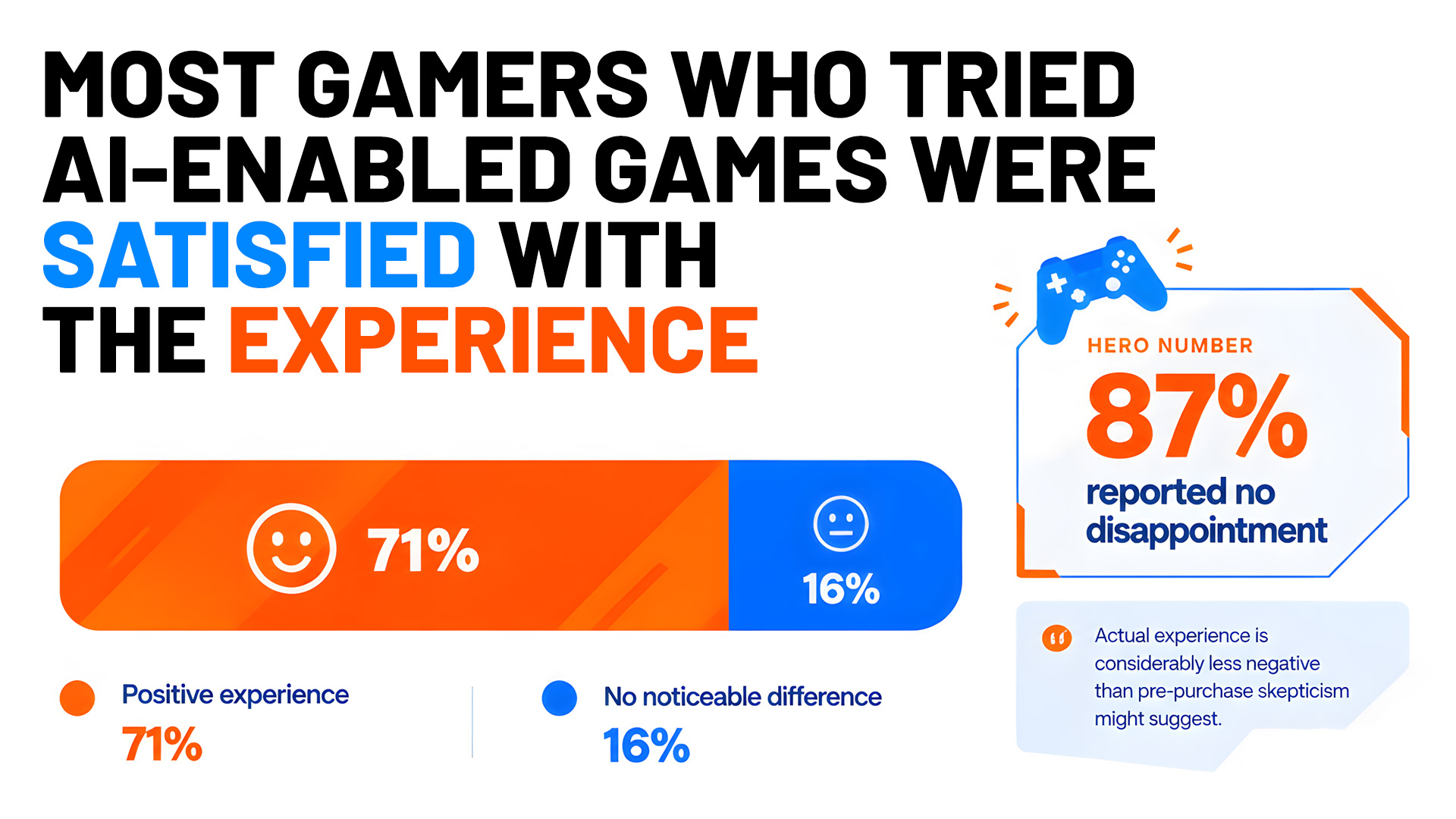
Among frequent gamers who knowingly purchased a game containing AI-generated content, 71% reported a positive experience, while another 16% said the AI made no noticeable difference.
That means 87% reported no disappointment.
There is another number worth paying attention to, though.
Only 5% of frequent gamers actively seek out games because they contain AI, compared with 12% of occasional players.
That may be one of the most commercially useful findings in the entire report.
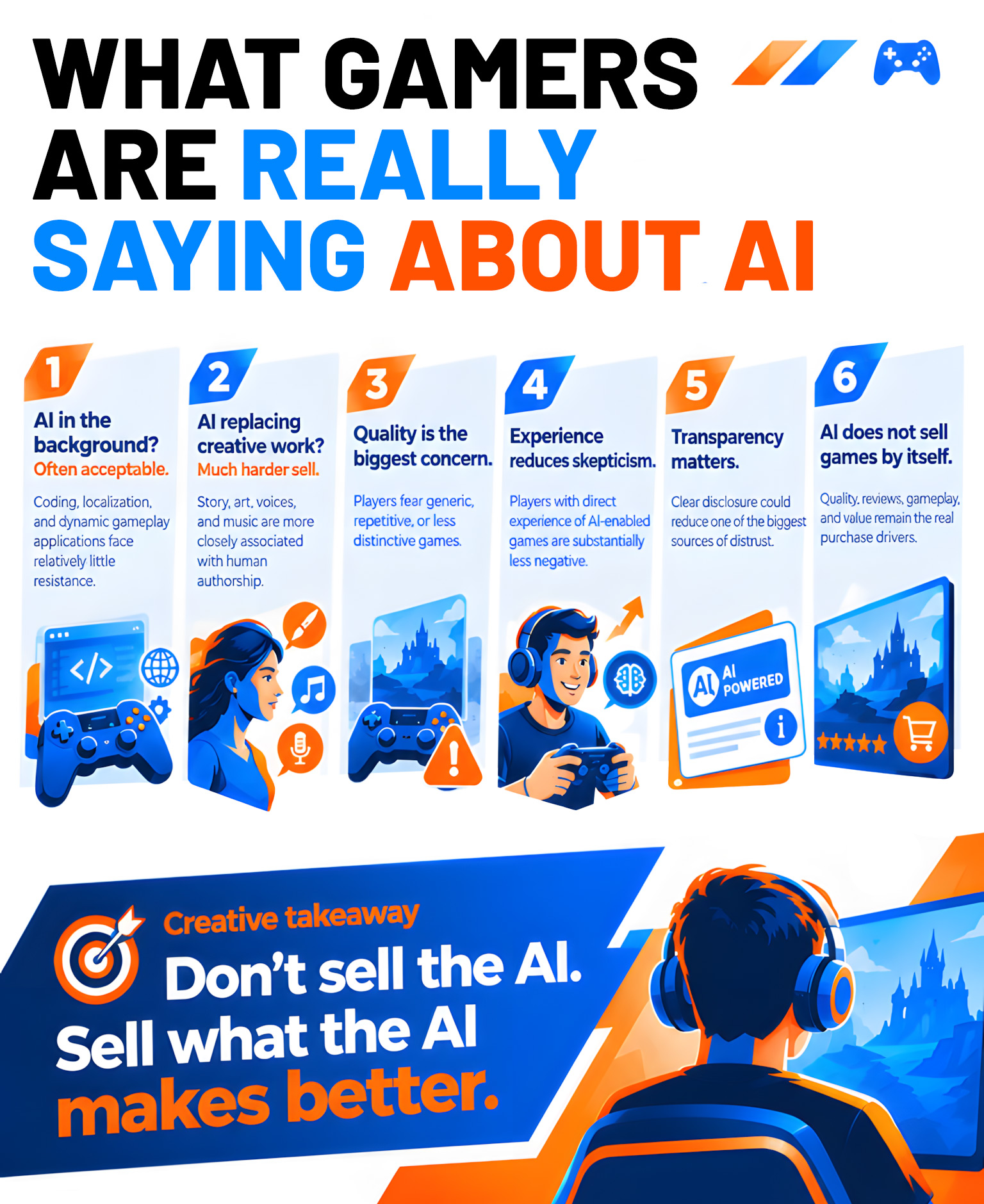
Players generally are not buying a game because it uses AI. They buy it because the gameplay looks good, the reviews are convincing, the mechanics appeal to them, or the price makes sense. If AI happens to be part of a good game, many accept it.
That makes AI much more convincing as an enabling technology than as a headline consumer benefit.
Where AI gets a pass, and where it does not
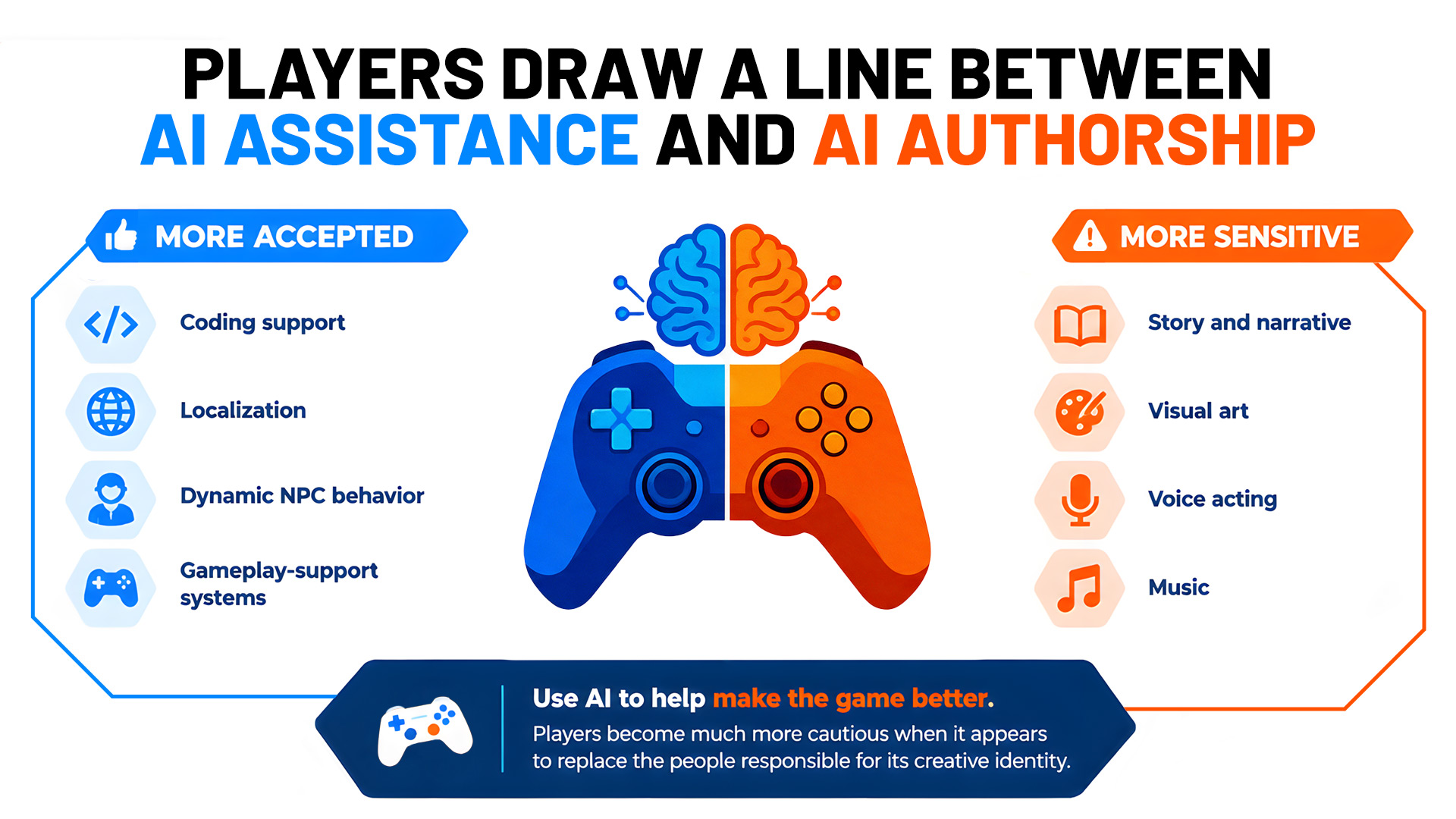
Frequent gamers respond best to AI when it improves the actual act of playing.
Dynamic NPC behavior attracts the strongest interest in this segment, followed by technical applications such as coding assistance and localization.
At the other end of the spectrum sit music and narrative.
Once again, the dividing line is not difficult to see. Consumers are much more comfortable with AI supporting a game than with AI appearing to replace creative authorship.
The communication lesson practically writes itself.
“AI makes NPCs react more dynamically” can be explained as a gameplay feature.
“AI generated significant parts of the story, soundtrack, or artwork” is much more likely to trigger questions about originality, authorship, jobs, and value.
What developers and publishers should take from this
If there is one thing the findings do not support, it is treating “AI” as a magic marketing word.
The practical lessons are much more grounded:
- Do not market AI as the main reason to buy a game. Most players are not actively searching for AI-enabled titles. Quality, reviews, gameplay, and value remain the real purchase drivers.
- Be precise about where AI is used. Consumers are considerably more accepting of technical support, localization, and dynamic gameplay systems than AI-generated art, writing, voices, or music.
- Introduce clear disclosure. An AI badge or comparable label directly addresses concerns about transparency and customers feeling misled.
- Lead with evidence of quality. Reviews, gameplay footage, demos, and credible player feedback can reduce pre-purchase fears, especially when direct experience appears considerably less negative than expectations.
- Expect price pressure. A substantial share of respondents believe games using AI should cost less, particularly frequent gamers and consumers in North America.
- Treat core gamers as demanding rather than simply anti-AI. They care strongly about creators, originality, transparency, and quality, but around 60% remain willing to buy an AI-enabled game if it earns strong reviews and delivers a convincing experience.
The bottom line: make a good game first
The research does not reveal a gaming audience neatly divided into “pro-AI” and “anti-AI” camps.
Players appear to judge AI much more pragmatically.
They are relatively comfortable with it when it supports development or makes gameplay better, and considerably more cautious when it enters areas strongly associated with human creativity.
The strongest barriers are expected loss of quality, loss of uniqueness, ethical concerns, pricing, and insufficient disclosure. Importantly, those concerns appear much stronger before consumers have direct experience with AI-enabled games.
Frequent gamers may be the toughest crowd, but even they are not broadly rejecting the technology.
The message from players is less “keep AI out of games” and more: make a good game, price it fairly, tell us exactly how AI was used, and do not use the technology as an excuse to strip away the human character of the medium.
For publishers and marketplaces, that means the opportunity is not to convince everyone to become excited about AI itself.
It is to reduce uncertainty, build trust, and let the quality of the game make the argument.