





The Blood of Dawnwalker’s 30-day time limit sounds much harsher than it actually is.

The Blood of Dawnwalker
Release Date: September 03, 2026
Genres: Role-playing (RPG), Adventure
There is no real-time countdown ticking away while you explore Vale Sangora. Instead, time works like a resource: specific quests, decisions, interactions, and upgrades consume clearly marked segments of the calendar.
That means you can scout the map, look for clues, prepare your route, manage your inventory, and simply explore without watching precious minutes disappear. The pressure begins when Coen actually commits to something.
Understanding that distinction is probably the most important thing you can learn before getting deep into The Blood of Dawnwalker.
Rebel Wolves built the system to make your decisions matter, not to force you to sprint through its open world.
This guide explains exactly how time works in The Blood of Dawnwalker, what advances the clock, how the eight time segments work, what the icons mean, how to switch between day and night, and what happens if you reach the 30-day deadline.
TL;DR – How time works in The Blood of Dawnwalker
Table of Contents
- How does time work?
- How do time segments work?
- What actually advances time?
- What can you do without spending time?
- Hourglass and clock icons explained
- How day and night affect gameplay
- How to wait and advance time
- What happens after 30 days?
- Can you miss quests?
- Best time-management tips
- More Dawnwalker guides
- FAQ
How does time work in The Blood of Dawnwalker?
Time is a resource, not a continuously running clock.
Coen has 30 days and 30 nights to rescue his family from Brencis, but standing around, wandering through Vale Sangora, or taking your time to investigate the environment does not cause that deadline to tick down second by second.
Instead, the calendar advances when you perform actions that have a time cost. The game normally signals those actions before you commit, allowing you to decide whether the outcome is worth spending part of your remaining schedule.
This is the key idea behind Rebel Wolves’ narrative sandbox. You are not being tested on how quickly you can cross the map. You are choosing which problems deserve Coen’s limited time.
Think of the timer as a budget: looking for a quest is usually free. Committing to an important step of that quest may not be. Scout first, spend later.
How do the eight time segments work?
The game’s day/night clock is divided into chunks rather than conventional hours.
Daytime contains eight segments, followed by eight nighttime segments. You can see the remaining portions of the current phase on the segmented time meter.
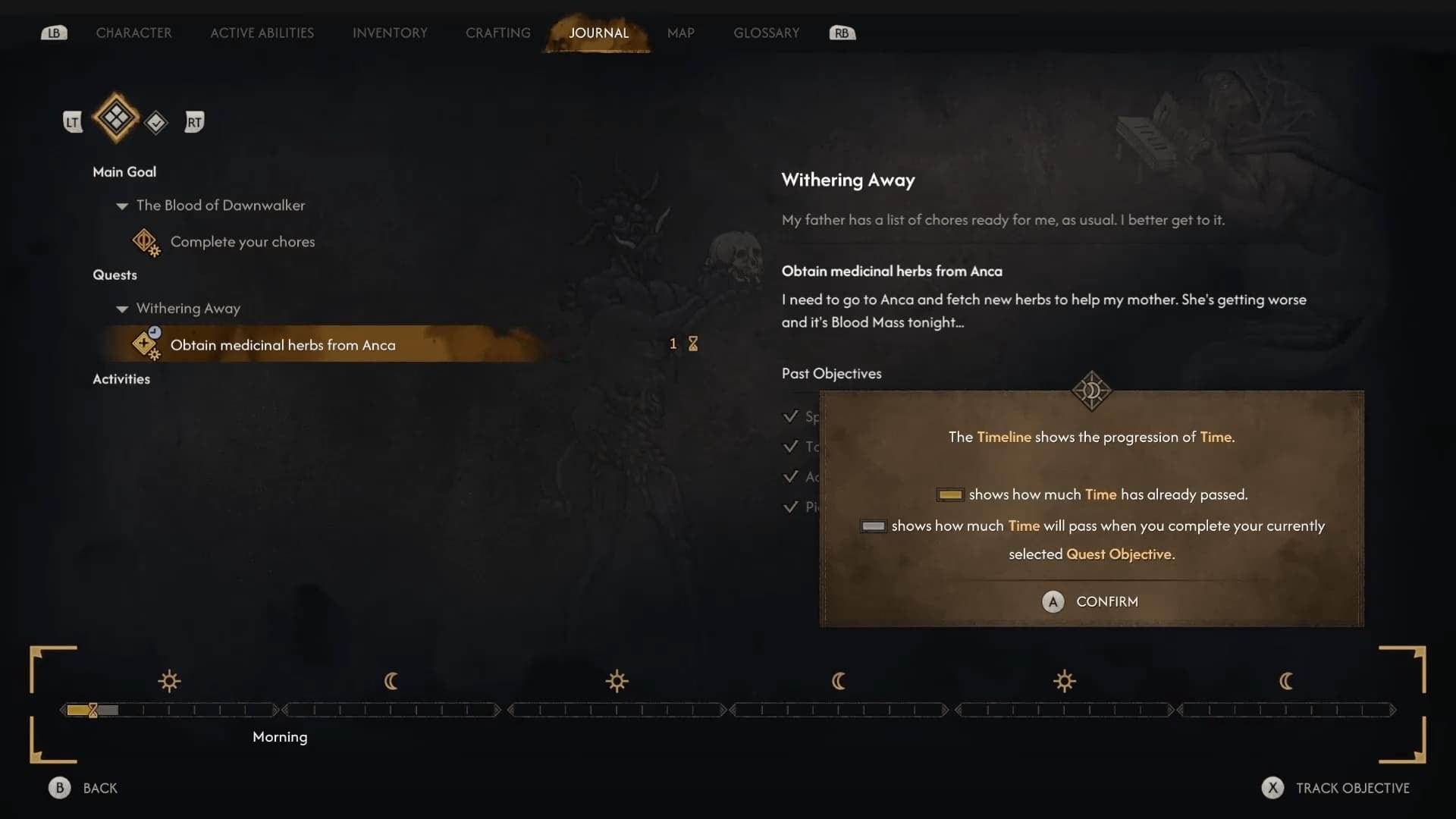
If an interaction costs two segments, completing it advances the clock by two notches. A more significant activity can consume more.
Time can also cross from one phase into the next. If you have one daytime segment remaining and perform an action costing three, the unused cost carries over after sunset, leaving you two segments into the night.
In other words, a complete day/night cycle gives you 16 potential segments to work with, but they are not completely interchangeable. Some characters, objectives, entrances, and abilities depend on whether the sun or moon is up.

What actually advances time?
This is where Dawnwalker can initially catch experienced RPG players off guard. The game does not simply charge time for “doing a quest.” Individual actions inside a quest can have different costs.
Activities reported to consume time include:
- important quest steps and resolutions;
- certain dialogue choices and interventions;
- some world events and points of interest;
- specific treasure or object interactions;
- learning or upgrading some abilities;
- choosing to wait at a Shrine;
- other interactions explicitly marked with a time cost.
The safest rule is therefore simple: watch the interface rather than assuming an activity is free or expensive because of its quest category.
Even apparently minor actions can sometimes spend time. For example, PC Gamer’s launch guide notes that getting caught stealing during the prologue wastes four segments dealing with the guard. Some Shrine upgrades can also consume part of your schedule.
What can you do without spending time?
The good news is that Dawnwalker gives you plenty of room to breathe.
Ordinary free-roaming does not continuously consume the 30-day timer. You can travel around Vale Sangora, inspect your surroundings, search for routes, manage equipment, and scout objectives without a real-time countdown running in the background.
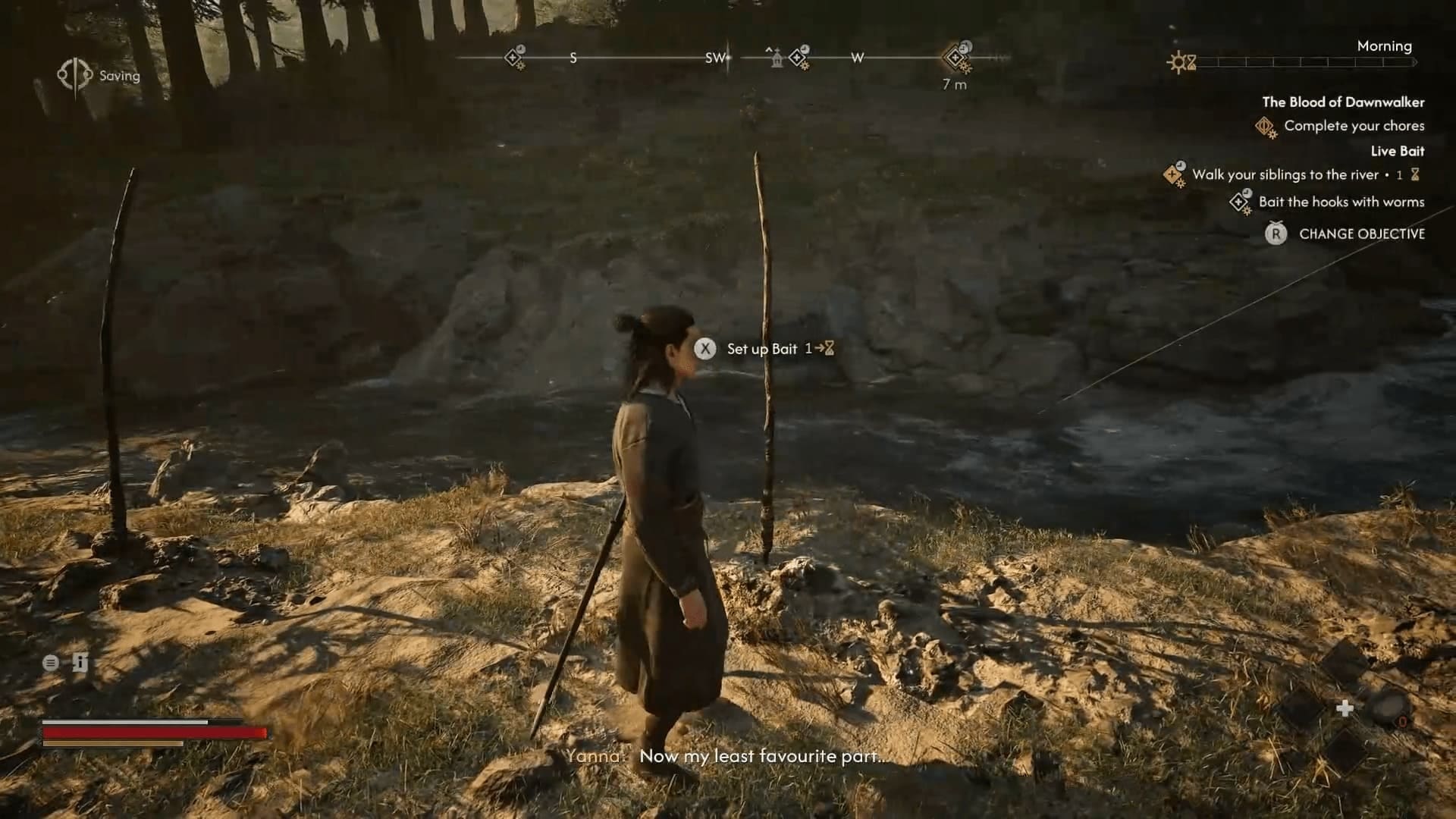
Simply leaving the game idle does not make hours disappear either.
Current launch-build coverage also indicates that fast travel itself does not consume a time segment. That makes it extremely useful for planning efficient routes between objectives.
Important: exploring an area may be free, but completing an activity you discover there may have a cost. A camp, world event, treasure interaction, or quest step can trigger an hourglass even though reaching it did not.
Hourglass and clock icons explained
You do not need to memorize every possible time cost. The UI does much of the work.
Get into the habit of checking the Journal before spending several segments elsewhere. If a quest has its own deadline, the log can tell you that something more urgent than the 30-day family objective is currently ticking.
Why day and night matter beyond the clock
Day and night are not just cosmetic lighting changes. They change what Coen is capable of doing.
During the day, Coen operates primarily as a human and has access to his human combat options and Witchcraft-related abilities. At night, his vampiric nature becomes dominant and opens a different set of supernatural powers and traversal possibilities.
The shift can also affect how you approach quests. An objective that is awkward during daylight may have an alternative route after sunset, while some NPCs and activities are tied to one phase.
So do not think only in terms of “How many segments does this quest cost?” Also ask “Do I want to spend those segments as human Coen or vampire Coen?”
That question can be just as important as the price.
How to wait and change from day to night
If you need a particular time of day, you can wait at a Shrine.
Shrines let you deliberately advance the clock, including skipping large portions of the current cycle. This is useful when an objective is only available at night or during daylight.
However, simply burning segments is rarely the most efficient option. If you need to advance the clock anyway, first check whether you have a useful quest step, skill upgrade, or other productive activity that costs time.
Spending four segments accomplishing something is usually better than spending four segments staring at the medieval equivalent of a bus timetable.
What happens when the 30-day timer runs out?
This section contains a minor consequence spoiler, but it answers one of the biggest questions surrounding the system.
Reaching the end of the 30-day deadline does not immediately end your save or force a restart.
If Coen fails to rescue his family in time, Brencis follows through on the threat against them. The story can then continue, but Coen’s central motivation changes from rescue to dealing with the consequences.
The important practical lesson is that Day 30 is a narrative deadline rather than a traditional game-over screen.
You can therefore fail the original objective and continue playing, but that does not mean the deadline is meaningless. It changes the story and prevents you from getting the outcome associated with successfully saving the family.
Can you miss quests in The Blood of Dawnwalker?
Yes. Time-sensitive opportunities can disappear if you spend too much of your schedule elsewhere.
That is intentional. Rebel Wolves does not structure Vale Sangora around a rigid distinction between “main content that matters” and “side content that can wait forever.” You decide which people, problems, and leads are important enough to pursue.
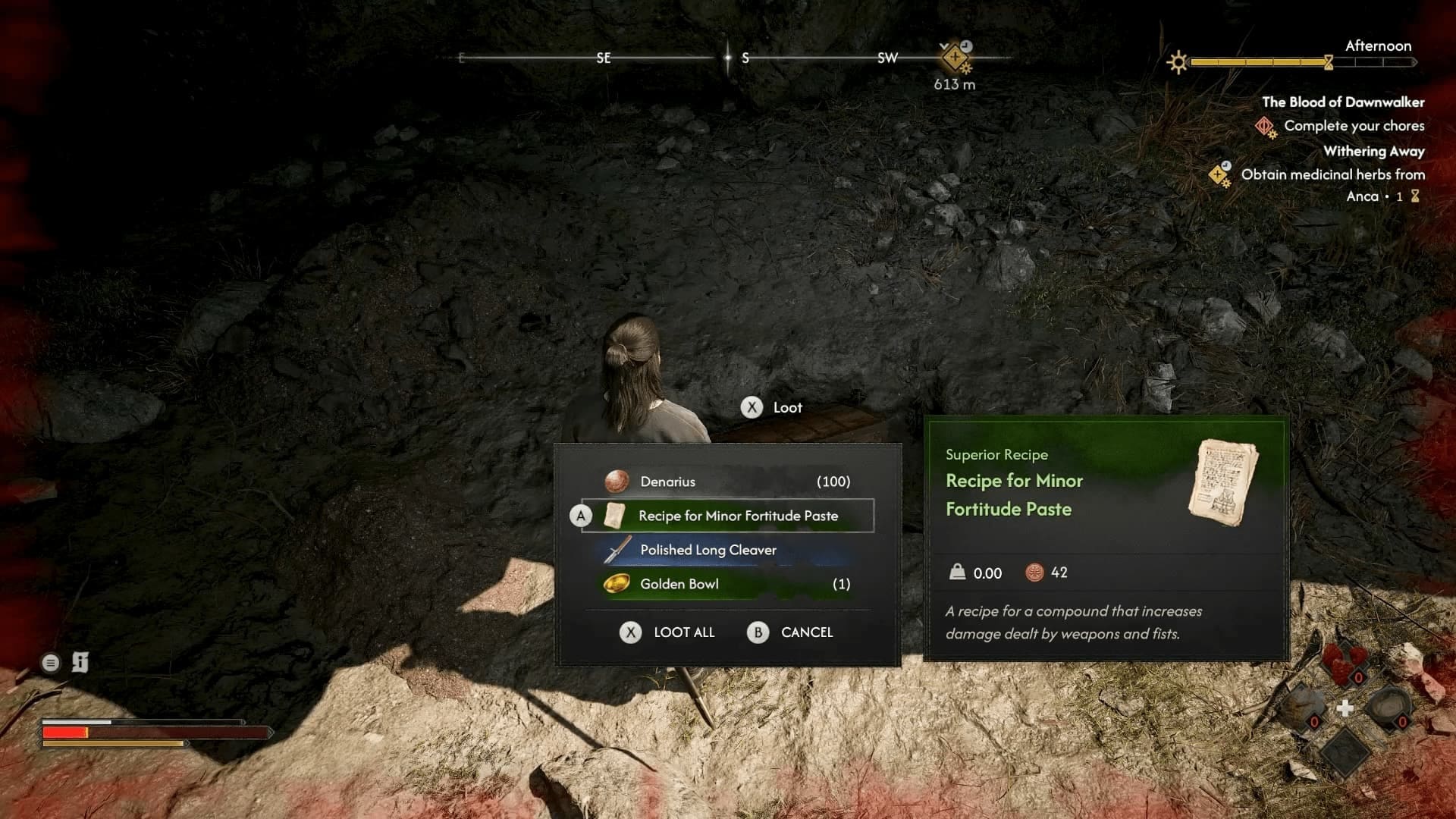
A missing person, for example, may not remain conveniently frozen in place while Coen spends several days solving unrelated problems elsewhere.
This also means you should not approach every quest marker with the usual completionist assumption that you can safely clear the entire map before continuing the story.
Best habit: whenever a new quest appears, open the Journal and check whether it has a deadline. A time-sensitive objective deserves attention before an activity with no immediate expiration warning.
Best ways to manage time efficiently
1. Explore before committing
Scouting is one of your biggest advantages because roaming itself does not run the story clock. Search an area, find entrances, identify NPCs, and learn what your options are before paying a time cost.
2. Read every hourglass prompt
The number beside the hourglass is effectively a price tag. Do not click through it automatically just because you are already standing beside the objective.
3. Prioritize quests with deadlines
A normal quest can often wait. One marked as time-sensitive may not.
4. Plan around human and vampire Coen
If an objective has different daytime and nighttime opportunities, choose the phase that better suits your build and desired solution.
5. Do not waste segments just to change the lighting
Waiting at a Shrine works, but spending that same time on a useful activity can give you progression while moving the clock toward the phase you need.
6. Be careful with skill training
Some progression choices also require time. Check the cost before treating a Shrine like a completely free skill menu.
7. Use fast travel
Fast travel is especially valuable because current launch-build testing indicates that moving between unlocked travel points does not spend a story segment.
8. Do not panic about the 30-day number
The mechanic exists to make choices meaningful. It does not mean you need to speedrun conversations, ignore exploration, or race across Vale Sangora.
Get more from G2A.COM with G2A Plus
G2A Plus Free lets you collect Plus Points on purchases, while Plus Premium adds member prices on eligible items, monthly rewards, exclusive discount codes, and priority post-purchase assistance.
More The Blood of Dawnwalker guides on G2A News
The Blood of Dawnwalker time system FAQ
Does time pass while exploring in The Blood of Dawnwalker?
No. There is no continuously ticking real-time countdown while you freely roam Vale Sangora. Time advances when you perform specific actions with a time cost.
How many time segments are in a day?
There are eight daytime segments followed by eight nighttime segments.
Does fast travel use time?
Current launch-build testing indicates that fast travel itself does not consume a story time segment.
Does combat consume time?
Ordinary combat does not automatically run a real-time clock, but completing a marked camp, event, objective, or other activity can have an attached time cost. Always check for an hourglass prompt.
Can you wait until night?
Yes. You can wait at Shrines to move the clock forward and switch between daytime and nighttime.
What does the hourglass mean?
An hourglass indicates that an action consumes time. The accompanying number shows how many segments will be spent.
What does the clock icon on a quest mean?
It indicates that the quest has its own time-sensitive element or deadline. Check the Journal before postponing it.
Can you miss quests?
Yes. Some opportunities can expire as the calendar advances, and your decisions about where to spend time are part of the game’s narrative structure.
Does the game end after 30 days?
No. Failing the 30-day family objective has serious story consequences, but your playthrough can continue.
Spend your time, don’t race against it
The Blood of Dawnwalker sounds stressful when somebody reduces its central mechanic to “you only have 30 days.” In practice, that description misses the most important part.
The clock waits for your decisions.
You can explore, scout, prepare, and think. The tension comes when the game asks whether saving one person, investigating one mystery, learning one ability, or pursuing one lead deserves a piece of a resource you cannot get back.
Once you stop treating the calendar like a stopwatch and start treating it like currency, the entire system becomes much easier to manage. And that is exactly what Rebel Wolves wants: not a race against time, but a reason to care how you spend it.