




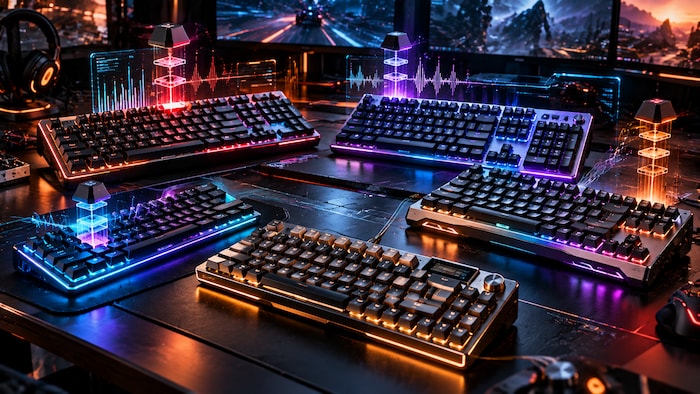
Picking a gaming keyboard in 2026 is harder than it used to be. Fast switches and low latency are no longer enough to stand out. Magnetic sensing, adjustable actuation, Rapid Trigger, 8000 Hz polling, better software, enthusiast-level construction, and genuinely good wireless performance are now competing for space on the same desk.
For competitive gaming, the Wooting 80HE+ is our top overall pick. The Razer Huntsman V3 Pro 8KHz is the strongest optical alternative, while the ASUS ROG Azoth Extreme is the premium choice if typing feel, wireless connectivity, and construction matter as much as raw response time.
The Qwertykeys HEX80 HE and MonsGeek FUN60 Ultra round out the list with two very different approaches: enthusiast-grade Hall effect hardware at the high end and unusually capable TMR technology at the value end.
Quick picks: Wooting 80HE+ is the best overall competitive keyboard, Razer Huntsman V3 Pro 8KHz is the best analog optical option, ROG Azoth Extreme is the premium wireless pick, HEX80 HE is the enthusiast Hall effect alternative, and MonsGeek FUN60 Ultra TMR delivers the strongest value.
- How we ranked the best gaming keyboards
- Gaming keyboard comparison
- 1. Wooting 80HE+ – Best overall
- 2. Razer Huntsman V3 Pro 8KHz – Best analog optical option
- 3. ASUS ROG Azoth Extreme – Best premium wireless keyboard
- 4. Qwertykeys HEX80 HE – Best enthusiast Hall effect alternative
- 5. MonsGeek FUN60 Ultra TMR – Best value
- Which gaming keyboard should you buy?
How we ranked the best gaming keyboards
This ranking rewards gaming performance first, followed by switch functionality, software, build quality, connectivity, customization, and price. An 8000 Hz polling rate alone does not automatically make a keyboard better, especially when several models now reach the same headline number.
For magnetic and analog boards, adjustable actuation, Rapid Trigger behavior, sensor consistency, and software matter just as much. For traditional mechanical keyboards, typing feel, wireless implementation, hot-swap support, and construction become more important.
This ranking is research-based, using current manufacturer specifications and independent keyboard testing rather than claimed first-hand testing.
Gaming keyboard comparison
| Keyboard | Layout | Switch technology | Connectivity | Polling | Best for |
|---|---|---|---|---|---|
| Wooting 80HE+ | 80% / TKL-style | Hall effect magnetic | Wired | True 8000 Hz | Competitive gaming |
| Razer Huntsman V3 Pro 8KHz | Full-size / TKL | Analog optical | Wired | 8000 Hz | Optical esports performance |
| ASUS ROG Azoth Extreme | 75% | Mechanical | Wired / 2.4 GHz / Bluetooth | Up to 8000 Hz with booster | Premium wireless builds |
| Qwertykeys HEX80 HE | 80% / TKL | Hall effect magnetic | Wired | 8000 Hz, 32 kHz scan | Performance plus enthusiast construction |
| MonsGeek FUN60 Ultra TMR | 60% | TMR magnetic / mechanical compatible | Wired or tri-mode, depending on version | Up to 8000 Hz | High-performance value |
1. Wooting 80HE+ – Best overall
The original Wooting 80HE already set a very high bar for competitive magnetic keyboards. In September 2026, Wooting replaced it with the 80HE+, a refreshed version that keeps the performance platform intact while changing several parts underneath the keycaps.
You still get True 8000 Hz polling with key scanning synchronized at the same rate, adjustable actuation, Rapid Trigger, per-key configuration, analog input, and Wooting’s extensive Wootility software. Wooting specifies an input interval of roughly 0.125 ms in its 8K mode.
The 80HE+ moves from the original model’s polycarbonate switch plate to FR4 and replaces the Lekker L60 V2 switches with Lekker Tikken Medium switches. Wooting has also revised the internal sound tuning and updated the case options. The Module version gains an optional split-spacebar layout.
The important part is what did not change: the performance and software ecosystem that made the 80HE such a strong competitive keyboard in the first place.
The 80HE+ starts at $199.99 for the ABS prebuilt, while the zinc version is considerably more expensive. If you already own an original 80HE, however, Wooting itself says there is little reason to upgrade purely for performance.
2. Razer Huntsman V3 Pro 8KHz – Best analog optical option
Razer takes a different route from the magnetic boards. The Huntsman V3 Pro 8KHz uses second-generation analog optical switches with adjustable actuation from 0.1 to 4.0 mm, Rapid Trigger, and True 8000 Hz HyperPolling.
The optical design also avoids relying on magnetic sensing for actuation. That does not automatically make it better than Hall effect, but it gives Razer a genuinely different technical approach rather than another variation on the same magnetic formula.
Razer also includes directional-input features such as Snap Tap on supported configurations. Features that alter how opposing movement inputs are resolved can be restricted by individual games or tournament rules, so competitive players should check the rules for the title they play rather than assuming every feature is legal everywhere.
The current US price is $249.99 for the full-size black model, while the black TKL version is listed at $219.99.
3. ASUS ROG Azoth Extreme – Best premium wireless keyboard
The ROG Azoth Extreme is not trying to beat Wooting at adjustable magnetic actuation. It is trying to combine gaming performance with the materials, acoustics, and customization associated with enthusiast mechanical keyboards.
The 75% board uses a full aluminum-alloy chassis, a carbon-fiber positioning plate, adjustable gasket mounting, pre-lubed ROG NX mechanical switches, hot-swap sockets, a color OLED touchscreen, and a substantial wrist rest.
Connectivity is a major advantage. You get USB, Bluetooth, and 2.4 GHz SpeedNova wireless. ASUS also supports an 8000 Hz report rate over USB and 2.4 GHz when using the included ROG Polling Rate Booster.
The Azoth Extreme makes the least sense if your only goal is competitive FPS performance. You are paying heavily for construction, acoustics, wireless operation, the OLED interface, and the overall enthusiast experience.
4. Qwertykeys HEX80 HE – Best enthusiast Hall effect alternative
The Qwertykeys and ATK HEX80 HE shows how far Hall effect keyboards have moved beyond purely esports-focused plastic boards.
Its case uses CNC-machined 6063 aluminum, while the internal design combines a carbon-fiber plate, gasket mounting, multiple layers of acoustic material, and OwLab Ti HE magnetic switches.
Performance specifications are serious too: 8000 Hz polling, a 32 kHz scan rate, adjustable actuation, Rapid Trigger, and other advanced magnetic-key functions through ATK’s software platform.
Direct pricing is currently $189, which makes the original $250 estimate too high. Availability can be less straightforward than with the large gaming brands because Qwertykeys sells the board in batches and specific color runs.
5. MonsGeek FUN60 Ultra TMR – Best value
The FUN60 Ultra is the wildcard in this list. It brings 8000 Hz polling, adjustable magnetic actuation, an aluminum chassis, and unusually flexible switch support into a price range that is normally associated with much simpler boards.
The version to pay attention to is the TMR model. Its tunnel magnetoresistance sensors support MonsGeek’s MagMech system, letting you combine compatible magnetic switches with standard 5-pin mechanical switches on the same keyboard.
That means you could use magnetic switches for movement keys where Rapid Trigger matters, while keeping conventional mechanical switches elsewhere if you prefer their typing feel.
Depending on the configuration, the FUN60 Ultra is available as wired-only or with 2.4 GHz wireless and Bluetooth. MonsGeek supports up to 8000 Hz polling in wired and compatible 2.4 GHz modes.
Current direct pricing ranges from roughly $60 to $90 depending on the FUN60 Ultra configuration. That makes it easily the least expensive keyboard in this ranking.
Which gaming keyboard should you buy?
For competitive gaming, the Wooting 80HE+ is the strongest overall choice here. Its advantage is not simply that it has an 8000 Hz polling rate. Several keyboards on this list do. The combination of fast analog input, mature Rapid Trigger implementation, per-key controls, strong software, and extensive switch support is what keeps it at the top.
The Huntsman V3 Pro 8KHz is the alternative if you specifically prefer analog optical switches and Razer’s esports-focused feature set. The HEX80 is a better fit if you want Hall effect gaming performance inside something that feels closer to a custom mechanical keyboard.
The Azoth Extreme is the luxury pick. It is expensive and does not offer adjustable analog actuation, but it delivers wireless flexibility and enthusiast-grade construction the competition-focused boards do not prioritize.
And if value matters most, the FUN60 Ultra TMR is difficult to ignore. Its compact layout is not for everyone, but the amount of switch technology and raw performance available for under $100 changes what a budget gaming keyboard can look like.