




Sony Interactive Entertainment has been granted a US patent describing a game controller that can operate without physical buttons.
Instead, it relies on adaptive input surfaces — with displays described as optional — capable of showing and dynamically reconfiguring virtual controls.
Does this mean we’ll get a “buttonless” DualSense bundled with the PlayStation 6? Not necessarily. Still, it’s a genuinely interesting signal from Sony’s R&D efforts, especially in the context of accessibility and customization.
TL;DR
- Sony has been granted USPTO US 12,533,573 B2, a patent covering a game controller with an adaptive input surface
- Touchscreen virtual buttons can change position and size based on hand placement and gestures such as tap, long press, and swipe
- Displays are optional in the patent and not required for the technology to function
- The concept could support controller accessibility design and personalization
- A patent grant and concept drawings are not a guarantee that such a controller will EVER reach the market
What the Patent Actually Describes
In practical terms, the patent explores a move away from fixed, physical button layouts toward surfaces that respond to touch and the way the controller is held. Instead of traditional buttons, sticks, or a D-pad, the device would rely on a combination of sensors — including capacitive touch controls, optical sensors, a pressure sensor, and even a temperature sensor — to detect finger placement and interaction.
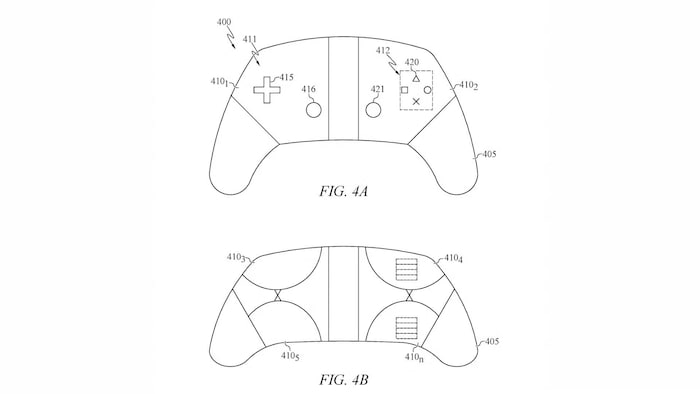
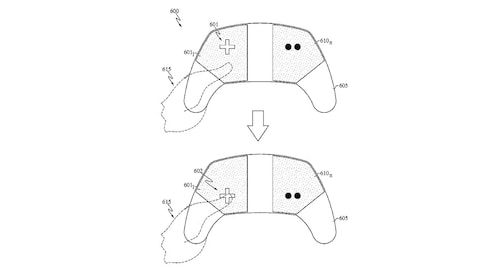
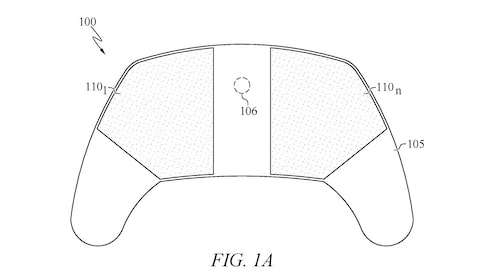
Based on this input, the controller could “draw” or dynamically illuminate active control zones directly on its surface. The control layout would no longer be static, but could shift in real time depending on hand size ergonomics, grip style, or the current gameplay context. The core idea is flexible input mapping, allowing a single device to support very different play styles and user needs.
Is it Really a “Buttonless” Controller?
This is where many headlines tend to oversimplify things. Some of the patent drawings do show futuristic controller concepts with no physical controls at all, sometimes featuring multiple display-like surfaces. However, that doesn’t mean Sony plans to abandon traditional buttons entirely.
The patent’s claims focus on adaptive input surfaces, not on eliminating physical inputs outright. In practice, any real-world implementation could just as easily be a hybrid — combining touch-sensitive areas with conventional buttons — or use this technology as a complement to existing designs. That is, if these concepts are ever implemented beyond the prototype stage.
Why Sony Might be Exploring This
The most realistic use cases for this technology don’t necessarily point to a hardware revolution. Instead, it appears to be about exploring possibilities and variations, some of which may eventually make their way into consumer products.
Accessibility
An adaptive control layout could reduce the need for multiple specialized controller shells. A single controller that can be reconfigured in software aligns closely with Sony’s broader approach to accessibility, as seen with the PS5 Access Controller, which was designed specifically for players with limited mobility.
Game-specific personalization
Different genres demand very different control schemes. Dynamic button layout systems could allow the controller to reconfigure itself depending on the game, the mode, or even a specific in-game situation.
Ergonomics and prototyping
From an R&D perspective, a single physical prototype capable of simulating dozens of layouts would save both time and cost when testing new ideas and control schemes.
Reality Check: a Patent is NOT a Product Announcement
It’s important to separate patent filings from actual product plans.
Large technology companies file for and receive hundreds of patents every year, most of which never become consumer products. According to external analysis by Parola Analytics, Sony Group alone received close to 2,300 USPTO patents in 2025, similar to previous years — with only a small fraction ever being commercialized.
In this case, the patent looks more like a way to protect an interaction method than a sign of an upcoming controller for PS5 or a future PS6. At the moment, there’s no indication that Sony plans to replace the DualSense or bring this concept to mass production.
FAQ
- Is Sony releasing a buttonless controller?
No. There is no confirmation that such a product is in development. Sony has only been granted a patent, USPTO 12 533 573 game controller, nothing more.
- What is the patent about?
It describes a controller using adaptive input surfaces that can display and dynamically adjust virtual controls based on user interaction.
- Will it replace the DualSense?
There’s no evidence to suggest that. For now, the patent should be treated purely as an R&D experiment, and an interesting technical concept.