




Why do we keep doing the same thing over and over in video games? Even when we know exactly what’s going to happen?
Grinding sounds boring on paper, right? It’s repetition, it’s slow, and it’s often just a way to get stronger numbers or better loot. And yet, somehow, it still pulls us in for hours. Crazy!
There’s something oddly satisfying about it. Maybe it’s the feeling of steady progress, maybe it’s the next reward just around the corner, or maybe it’s just how our brains are wired to chase small wins.
But it also raises a weird question, I think. Are we actually enjoying the grind, or are the games just really good at making us feel like we are?
What Grinding Really Means in Modern Gaming
Grinding used to just mean repeating the same task over and over until you got stronger or earned enough currency. Think about:
- fighting the same enemies
- running the same dungeon
- farming the same resource
- complete the same quests daily
But in modern games, it’s a lot more layered than that. Grinding is now built into the structure of progression itself, which is less obvious, more structured, and often designed to feel like steady achievement rather than repetition.
Today’s grinding shows up in different forms, such as:
- daily and weekly quests that reset and create routine play
- battle passes that reward consistent engagement over time
- loot systems with randomized rewards that encourage “just one more run”
- skill trees and upgrade paths that stretch progression into long-term goals
- time-gated events that control when and how progress can happen
Instead of feeling like pure repetition, grinding now blends into the overall game loop. You’re still doing similar actions, but the system wraps them in constant feedback, progression, and rewards that make it feel like you’re always moving forward.
Why Players Grind: The Brain’s Reward Loop
Grinding works because it connects directly to how our brains handle rewards and anticipation. Every level-up, loot drop, or upgrade gives a small dopamine boost. However, what really keeps players going is the chance that something good MIGHT happen next.
Game systems are often designed around this uncertainty. Instead of rewarding you every time, they space rewards out just enough to keep you engaged, turning repetition into anticipation.
Why does grinding feel so sticky?
- Dopamine is driven by anticipation, not just rewards.
- Random drops keep players curious and engaged.
- Small progress hits feel more motivating than big milestones.
- Near-misses encourage “one more try” behaviour.
- Constant feedback (XP bars, levels) reinforces progress.
So grinding isn’t just repetition, but it’s rather a loop of expectation, uncertainty, and reward that keeps us coming back longer than we actually planned.
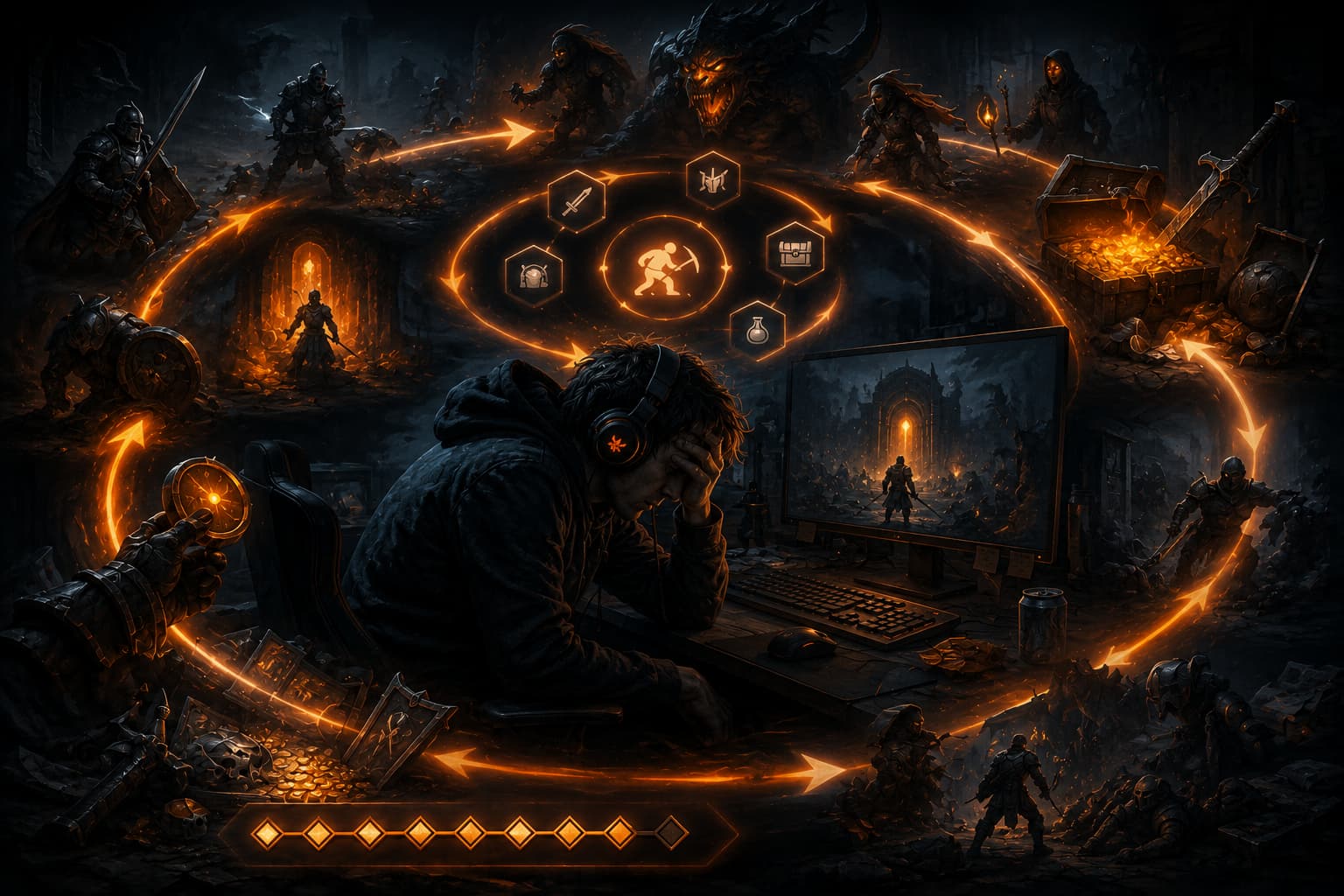
When Grinding Becomes Burnout
Grinding is fun at first, but it can slowly start to feel tiring. What used to feel like progress can turn into doing the same things over and over, just to keep up.
That’s when burnout happens. The game doesn’t feel exciting anymore, rewards don’t feel as good, and you might even play out of habit instead of enjoyment.
It usually looks like this:
- Everything starts feeling repetitive.
- Rewards don’t feel exciting anymore.
- You play because you feel like you have to.
- Progress feels slow or pointless.
- The game feels more like work than fun.
When it gets to this point, grinding stops being enjoyable and just feels exhausting.
Grinding in Competitive vs. Casual Games
Grinding means different things depending on the game. In casual games like MMORPGs, RPGs, and mobile games, you grind to level up, get better gear, and unlock new content. Repetition is just part of how you progress.
In competitive games, grinding is more about improving your skills. You’re not farming items, but you’re practicing to play better than other players.
Let’s take a closer look how it works in different genres:
- casual games > grind for rewards and progression
- competitive games > grind for skill and improvement
- RPGs/MMORPGs > long-term character growth
- Esports games > practice and mastery
As you can see, it’s the same idea of repetition, but totally different goals.
Can Games Exist Without Grinding?
Not all games need grinding to keep players interested. So, how can games stay engaging without grinding?
- Some focus on skill, where you improve by playing better.
- Others use story rewards, where you progress through the narrative.
- Some adjust difficulty, keeping things challenging without repetition.
- Some reward exploration, where discovery replaces repetition.
- Others use creative freedom, where players set their own goals.
Summing up, games can still feel rewarding without grinding, but it makes me wonder…do we enjoy progress more when we earn it through repetition, or when it’s simply part of the experience?