
Some games have a reputation for being nearly impossible. Forums are full of “git gud” jokes, and many casual players steer clear. But here’s the real question: can these so-called hardest games actually be fun if you’re not a masochist?
Turns out, they can. Extreme difficulty can push players away, but it also creates a payoff that’s hard to beat. When you finally win, it hits different.
In this piece, we’ll look at some of the toughest games ever made and what game designers — and research — say about the link between difficulty and fun.
The hardest games of all time: a quick list
Cuphead (2017)
On Steam, only around 12.6% of players finished the full game on Normal difficulty. On Xbox, it was even lower, about 7% beat the final boss. On PlayStation, where the game launched later, around 33% earned the trophy for completing it. That suggests the PlayStation crowd was mostly fans who knew what they were getting into and stuck it out.
Dark Souls (series)
People love to talk about how brutal these games are. But the numbers say a lot of players actually push through. On PlayStation, nearly half of Dark Souls III players made it to the second-to-last boss. The first Dark Souls saw a 37% completion rate, Dark Souls II hit 38%, and Bloodborne came in at 32%. That’s not casual-friendly, but it’s far from impossible. Souls fans know how to take a beating.
Sekiro: Shadows Die Twice (2019)
Completion rates swing wildly depending on where you play. On Steam, about 30 to 32% of players beat the final boss, Isshin. On PS4, though, only 11.9% got the trophy for finishing the main ending, and just 5.4% completed the Shura ending. That shows a big chunk of console players gave up before the end.
Super Meat Boy (2010)
This one’s brutal. Only about 6.6% of Steam players finished all the Light World levels and took down the final boss. Finishing without dying? That’s deep in fraction-of-a-percent territory. Other platforms tell the same story. Most players just drop it before the end.
Returnal (2021)
A tough roguelike that pushed a lot of people away. Trophy data on PS5 shows that between 70 and 77% of players bailed before finishing. Only 30.3% beat the first act boss, about 23% got through act two, and just 10% reached the third act and its hidden ending. Not having a normal save system didn’t help either.
Ghosts ’n Goblins
The old arcade version from 1985 demanded two full playthroughs for the real ending, and barely anyone made it that far. The 2021 reboot kept that tradition alive: only about 1% of Xbox players unlocked the true ending. That’s one of the lowest completion rates you’ll see today.
Ninja Gaiden
These games have always been tough, and the numbers back it up. On Xbox 360, 26% finished Ninja Gaiden II on the easiest setting. Just 12.7% made it through on normal, and only 0.6% survived Master Ninja. On PS3, Ninja Gaiden Sigma’s hardest difficulty saw only 2 to 3% of players finish. Most never get through it on normal.
Battletoads
The original 1991 game was infamously difficult. Even with infinite continues in Rare Replay’s 2015 version of Battletoads Arcade, only 11% of players finished all six stages. The rest bailed before the end.
Drop-off rates in high-difficulty games
In Returnal, only about 23 percent of players made it past Act Two. Just 10 percent reached the hidden third act. That means nearly 77 percent gave up before the end.
Soulslikes show the same pattern. In the Dark Souls series, only around 30 to 35 percent of players reach one of the endings.
In Sekiro: Shadows Die Twice, the trophy for beating early-game boss Genichiro was unlocked by just 41.7 percent of Steam users and 44.8 percent on PlayStation. And that’s not even a final boss, it’s one of the first big fights. Still, almost half of the player base never gets through it.
Data shows that only about 10 to 20 percent of players actually finish the games they buy. Even something short and well-loved like Portal doesn’t break the trend. Less than 49 percent of players have the “Heartbreaker” achievement for completing it.
Why does this happen? Maybe it’s the length. Maybe it’s the difficulty. Or maybe people just get frustrated. Either way, the harder the game, the faster players seem to drop off.
Player perception of difficulty (casual vs. hardcore)
Casual and hardcore players see difficulty differently. Casual players treat games as fun or a way to relax. They’ll go for lower difficulty, even if they’re good, just to keep things chill.
Some players want games to be hard. They like the challenge and the feeling of getting better. That’s why games like Dark Souls or Ninja Gaiden work for them. But for others, that same difficulty is just too much, and they stop playing early.
It’s not only about skill. A new player might be good but still choose easy mode. And someone with a lot of experience might need high difficulty to stay interested. What matters most is finding the level that feels right for you.
The concept of flow
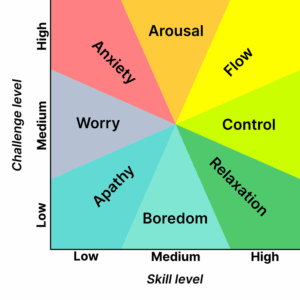
The psychologist Mihály Csíkszentmihályi introduced the idea of flow in the 1970s.
Flow is when you’re totally focused, fully into what you’re doing, and it just clicks.
For flow to happen, skill and challenge have to match. Too hard, and you feel anxious. Too easy, and you get bored. Csíkszentmihályi mapped it out: there’s a sweet spot between stress and boredom.
That’s the flow channel.
Game designers use that idea to keep you locked in. When the balance is right, games feel great. You’re challenged but not overwhelmed.
But if the balance is off, it just feels like a grind. Matching difficulty to what the player wants is key.
Most people don’t finish really hard games.
But what about the ones who do? They tend to be hardcore players who actually enjoy the challenge. For them, difficulty makes the game better.
For casual players, too much difficulty can ruin the fun. But if the challenge matches what they expect and want, they can even feel satisfied.