



CD Projekt Red is once again firing up the imagination of its fans. During the latest investor call, the studio’s CEO Michał Nowakowski revealed a bold ambition: to create an entirely new Witcher trilogy and release all three games within six years of the first one launching.
Ambitious? Absolutely. Possible? Well… that’s where things get interesting.
So What Exactly Is Going On?
The Polish studio pulled back the curtain on some of its biggest franchises — and when it comes to The Witcher, one detail stands out. CDPR has officially shut down speculation about a 2026 release for The Witcher 4. Next year’s premiere is simply not happening.
The earliest realistic window is 2027. Even that isn’t locked in, as nothing has been formally confirmed beyond the fact that the project has entered its full-scale production phase, a key milestone in the studio’s CD Projekt Red development plans. As Nowakowski put it:
“We’re not disclosing any details regarding the target release date (…) The only thing we’re commenting on is that we’re not launching in 2026.”
The second major announcement is even bigger: CDPR intends to release the entire new Witcher trilogy — parts 4, 5, and 6 — within a six-year period. Or, in Nowakowski’s words:
“As we had stated before, our plan still is to launch the whole trilogy within a six-year period… which means shorter development time between The Witcher 4 and The Witcher 5, between TW5 and TW6 and so on.”
Using 2027 as a reference point for the first release, this new Witcher trilogy release timeline points to follow-up entries arriving around 2030 and 2033.
What’s Supposed To Make This Pace Possible?
The biggest theoretical advantage is CDPR’s transition to Unreal Engine 5, a huge shift after more than a decade on the proprietary REDengine. Switching to a heavily documented, widely used, stable tool set could — at least on paper — streamline the production pipeline. Instead of constantly building custom tech, the studio now taps into a ready-made ecosystem.
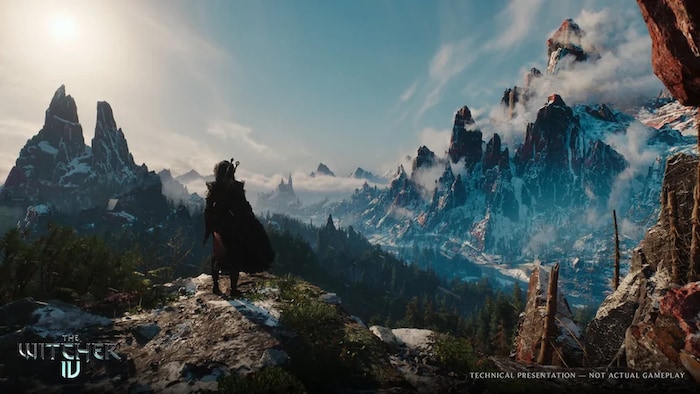
Behind the scenes, CDPR is also pushing for stronger process standardization. The studio already showcased early ideas during a UE5 tech demo at Unreal Fest, emphasizing how the engine allows faster prototyping, testing, and iteration. In theory, this means each new game in the trilogy can build on an increasingly polished workflow — a major benefit for large-scale AAA development.
But that’s only half the story.
Why It Could All Fall Apart?
A shiny new engine looks great in presentations, but in real life it’s a massive challenge. Even giant, experienced studios stumble on their first big projects after a major tech shift. And CDPR is taking on a lot at once: learning UE5 to a level where it can support sprawling open worlds, creating new tools, restructuring workflows, and training a team of over 400 people — all while racing against the expectations set by this ambitious franchise roadmap.
This leads to the obvious question: is that six-year window based on an ideal scenario where everything goes perfectly, nobody gets sick, no one leaves the company, and the tech behaves exactly like the marketing materials promise?
And that’s not all. CD Projekt Red is juggling more than just The Witcher 4. There’s also the mysterious “other project”, details of which are kept close to the chest by the studio, plus the Witcher 1 Remake, also being built in UE5. That remake is handled by Fool’s Theory — a team that, notably, has partially shifted to support Witcher 4. In other words, resource allocation is fluid, and every additional project introduces pressure that could slow down the entire machine.
How Does This Compare To The Rest Of The Industry?
In the world of large-scale RPGs, especially titles relying on complex open-world engine systems, ambitious timelines usually lead to delays… or to launch-day problems. BioWare did manage to ship the Mass Effect trilogy within five years, but it was a uniquely favourable situation — one engine, consistent tech, and plenty of reusable elements. And even then, Mass Effect 3 showed visible signs of production fatigue.
The Witcher series is not that kind of franchise. These games are built as massive, highly detailed open worlds with huge quest networks, tons of animations, and deeply layered systems. And both The Witcher 3 and Cyberpunk 2077 experienced significant delays — with the latter known for launching in a state that forced CDPR into years of damage control and internal restructuring.
History suggests, then, that CDPR’s timeline is… let’s say, extremely optimistic.
What Does This Mean For The Brand And The Studio?
The Witcher is not “just another game” for CDPR — it’s the foundation that launched the studio into global recognition. Returning to the franchise after years of silence is a huge opportunity for renewed momentum, reputation rebuilding, and long-term financial stability.
If successful, this ambitious CD Projekt Red development plan could maintain constant fan interest, create a predictable multi-year content cycle, stabilize revenue streams, and fuel long-term growth, including more hiring and more studios — the kind of machine already visible at Ubisoft, a company with nearly 19,000 employees and around 45 studios publishing games every 1–2 years.
But there’s a catch. Communication must remain transparent, and the quality bar needs to stay consistently high. After the launch of Cyberpunk 2077, players are far more cautious and significantly less forgiving of broken promises.
So… Is It Realistic Or Not?
Looking at everything together, we can build two parallel narratives.
On one hand: yes, it genuinely could work. UE5 opens huge possibilities, the studio has money and experience, and the trilogy could benefit from shared technology, assets, features, and a maturing Unreal Engine 5 transition workflow. If Witcher 4 becomes a solid technological foundation — and a financial hit — the next entries could indeed appear much faster.
On the other hand, this is the kind of plan that requires near-perfect synchronization. In game development, almost nothing goes perfectly. Producing three massive RPGs in such a tight window is something we normally hear from marketing departments, not development teams.
The most honest answer, then, is this… Yes, it’s possible — but only if CDPR truly transforms the way it works, keeps its teams stable, and fully masters the Unreal Engine 5. If Witcher 4 launches strong, it could create a domino effect that accelerates the next entries. But the bar is extremely, extremely high.