





Dog in the Machine looks like Into the Breach after somebody replaced the mech squad with one extremely customizable robot dog. Battles happen on compact grids where positioning, collisions, hazards, and chain reactions matter more than raw damage. The twist is that you keep teaching your AutoDog new Tricks, combining attacks into custom abilities until the good boy has effectively become your own tactical build.
Developed by Studio Chahut and published by Goblinz Publishing, Dog in the Machine launches on Steam on September 29, 2026. The reason to keep in on your radar is how neatly its ideas overlap with one of turn-based strategy’s smartest games without simply copying it.
Into the Breach gives you a tiny battlefield and asks you to manipulate everything on it. Dog in the Machine seems to ask the same basic question, then hands you a dog-shaped ability editor.
Table of Contents
- What is Dog in the Machine?
- Why the Into the Breach comparison works
- The real hook is modding your dog’s moves
- Every battlefield is built for chain reactions
- You can rehearse a turn before committing
- The dog changes from run to run
- Dog in the Machine release date and demo
- Who should keep an eye on Dog in the Machine?
What is Dog in the Machine?
Dog in the Machine is a single-player tactical roguelite about an AutoDog trying to escape a dystopian mecha-city and reunite with its exiled humans.
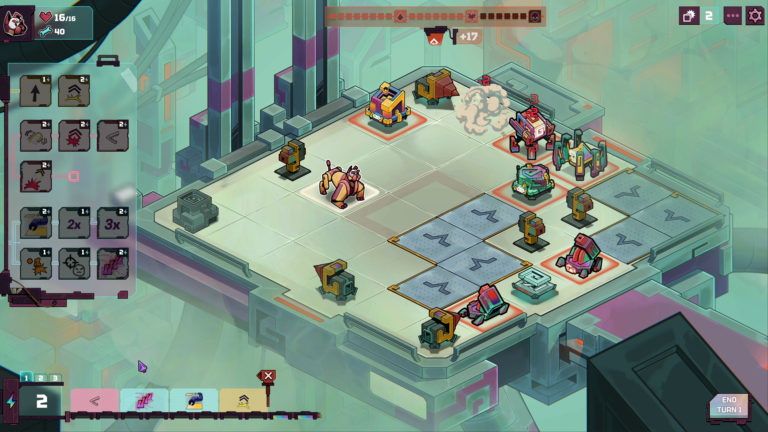
Each encounter takes place on a small grid packed with enemy robots, environmental hazards, interactive machinery, and opportunities to send several things catastrophically wrong at once.
The goal is not simply to walk toward the nearest robot and bite it until its numbers disappear.
You are supposed to treat the entire board as a machine.
Push one enemy into another. Redirect an attack. Trigger an explosive object. Use a conveyor belt to change positioning. Hit a button at the right moment and let the environment finish the job.
That is where the Into the Breach comparison starts becoming difficult to ignore.
Why the Into the Breach comparison works
Dog in the Machine is not pretending to be Into the Breach with different sprites, but the two games share some very recognizable tactical DNA.
| Into the Breach DNA | Dog in the Machine |
|---|---|
| Compact tactical grids | Small generated arenas where every tile and object can matter |
| Displacement is often as useful as damage | Collisions and repositioning can turn enemies and hazards against each other |
| Turns feel like tactical puzzles | Boards are designed around finding an efficient sequence and triggering domino effects |
| Readable consequences reward planning | A preview timeline lets you simulate your instruction sequence before committing |
That last point creates the biggest philosophical difference.
Into the Breach gives you information and then asks you to solve the turn correctly. Dog in the Machine goes further by letting you preview the sequence itself, cancel it, change the plan, and try again before committing.
It is tactical puzzle-solving with a rehearsal button.
For more compact grid tactics, our best “one more run” games feature also covers why Into the Breach remains so effective.
The real hook is modding your dog’s moves
This is where Dog in the Machine develops its own identity.
You are not literally bolting increasingly ridiculous mechanical legs onto a Labrador. The “modding” happens through the AutoDog’s Trick Library.
After battles, the dog learns new Tricks. More importantly, you can combine two Tricks to create a more complex ability.
Blueprints provide suggested combinations, but you are also free to experiment and build your own. By the later stages of a run, the idea is that your dog should no longer behave like the same tactical unit you started with.
One build might lean hard into displacement and collisions. Another could be built around repeating or multiplying useful actions. Another might exploit the specific hazards and movement tools you have collected.
It is essentially deckbuilding applied to a robot dog’s command list.
That makes the buildcraft feel unusually tangible. You are not merely choosing a percentage upgrade after combat. You are changing what commands your unit can perform and how those commands interact with one another.
Every battlefield is built for chain reactions
Studio Chahut describes the combat arenas as chain-reaction playgrounds, and the environmental systems explain why.
Boards can contain conveyor belts, switches, explosive obstacles, reactive enemies, and collision systems. The useful question is therefore not always “How much damage does this attack deal?”
It may be:
“What happens to the rest of the board if I hit this robot from this direction?”
That is the good stuff in games like Into the Breach. A technically weak attack becomes the correct move because it pushes one enemy out of position, blocks something else, redirects another threat, and turns a messy board into a solved problem.
Dog in the Machine seems interested in making those cascades even more elaborate.
Instead of commanding three mechs with established kits, you keep rebuilding one AutoDog so it becomes progressively better at creating the kind of domino effects your current run favors.
You can rehearse a turn before committing
The preview system could be the feature that determines whether Dog in the Machine feels pleasantly cerebral or exhausting.
Turn-based chain reactions can become difficult to calculate once several enemies, hazards, pushes, and movement effects are involved. Rather than forcing you to mentally simulate every step, Dog in the Machine lets you watch the planned sequence play out before locking it in.
You can then cancel it, reorder instructions, and experiment again.
That does not necessarily make the puzzle easier. It changes where the difficulty sits.
The challenge becomes finding the best solution instead of losing because you misunderstood which robot would collide with which barrel three actions into a sequence.
That is a meaningful distinction from Into the Breach, which is more comfortable letting a single mistaken calculation become part of the run.
The dog changes from run to run
Dog in the Machine then wraps those battles in a roguelite structure.
Steam lists eight playable dog breeds, procedurally generated levels, and permanent upgrades and features that can be unlocked between attempts.
Between battles, you also meet characters living inside the machine-city. These encounters can expand the Trick Library through buying, exchanging, looting, upgrading, or stealing.
So there are really two tactical decisions happening at once.
You need to solve the board in front of you, but you are also assembling the version of the AutoDog that will have to solve whatever comes next.
That broader run structure places the game comfortably in the strategy-roguelite family alongside titles such as Into the Breach. Our roguelike vs. roguelite guide breaks down where that distinction comes from.
Dog in the Machine release date and demo
Dog in the Machine launches September 29, 2026 on Steam, with Windows and macOS requirements currently listed.
The announced launch price is $17.99 / €17.99, with a 20% discount planned for its first two weeks.
There is also a free Steam demo available now. As of September 28, that demo holds a Very Positive rating, with 98% of 66 user reviews positive. That is a small sample rather than a verdict on the finished game, but it is a useful early signal one day before launch.
If you would rather try before buying, the Dog in the Machine demo is available on Steam.
Planning to pick it up on Steam?
You can check Steam Gift Cards on G2A.COM and add funds to your Steam Wallet before launch.
Pay less, gain more with G2A Plus
G2A Plus Free lets members earn Plus Points on eligible purchases and use them to pay less on future orders. Premium also adds better member prices, regular gaming rewards, and priority help after purchase.
Who should keep an eye on Dog in the Machine?
The obvious audience is anyone who enjoys Into the Breach’s compact tactical puzzles but wants more freedom to create the unit doing the solving.
The shared appeal is positioning, displacement, small battlefields, and making one clever action solve several problems at once.
The difference is the buildcraft.
Dog in the Machine is less about mastering a fixed squad and more about teaching one mechanical dog an increasingly strange collection of custom commands over the course of a run.
Players who enjoy deckbuilding roguelites should also recognize the pleasure of taking individually simple components and discovering that two of them together create something much more useful. Our best deckbuilding roguelikes explores more games built around that kind of synergy hunting.
Teach the dog, break the machine
There is something immediately appealing about Dog in the Machine’s pitch.
Into the Breach proved that a tiny grid can support absurdly deep tactical problems when enemies, positioning, and environmental manipulation all interact cleanly.
Dog in the Machine appears to take that same love of domino-effect strategy and shift the emphasis from which squad did you choose? to what did you teach the dog?
That is a strong enough hook on its own.
The fact that the dog can shove hostile robots into explosions is just good training.